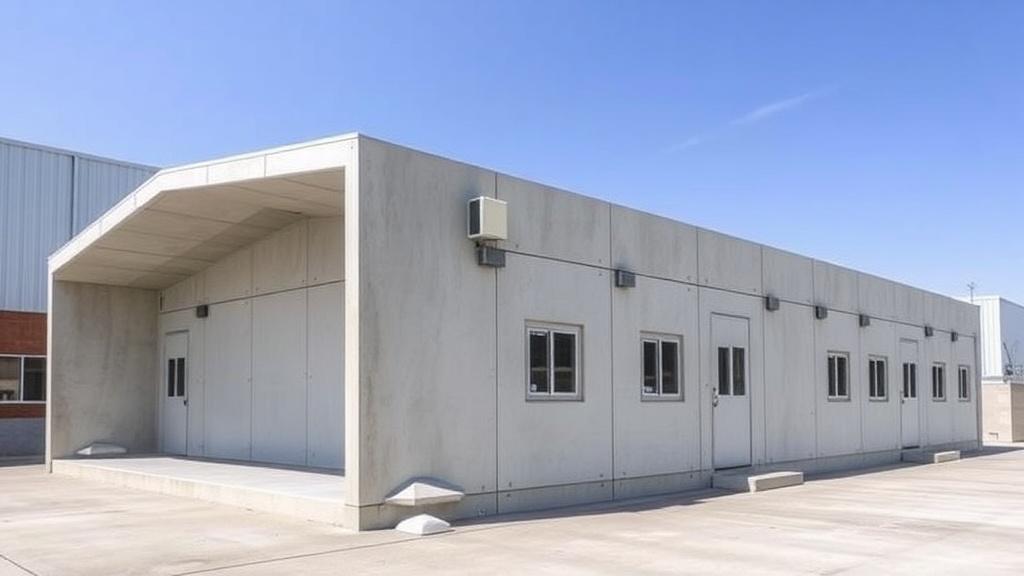
The Housing Crisis Nobody Is Winning
Every year, wildfires, hurricanes, and floods displace hundreds of thousands of Americans. Cities spend 3–6 years and $531,000–$837,000 per unit building traditional homeless housing — and people are still on the streets. The math hasn’t worked for decades.
Something has to change.
Modular precast and Glass Fiber Reinforced Concrete (GFRC) shelters represent a fundamentally different approach: units engineered for speed of deployment, reusability across multiple disaster cycles, and a 50+ year service life — all at a fraction of the lifecycle cost of traditional construction or shipping containers.
Mesa Precast specializes in panelized GFRC and precast modular units built to ASTM standards, designed for rapid deployment in disaster relief scenarios and permanent homeless housing applications. Contact Jess Mason at jmason@mesaprecast.com or (480) 600-6776.
The Problem: Why Current Solutions Fail
Disaster Displacement: Speed Matters More Than Anything
After Hurricane Helene struck western North Carolina in late 2024 — causing approximately $60 billion in damage — Amish construction teams deployed 12 modular tiny homes in under 48 hours. Meanwhile, traditional site-built recovery efforts were still in the permitting phase.
The data is unambiguous: prefabrication cuts on-site labor by 65% and shrinks deployment timelines to 72 hours (Disaster Response Journal, 2024). Every hour shaved from shelter deployment reduces mortality risk in disaster zones.
FEMA itself identified the problem with its traditional response: trailers are meant for a maximum of 18 months. After Hurricane Andrew, the agency found modular construction sustained “relatively minimal structural damage” compared to other building types — yet legal restrictions limited FEMA’s ability to use modular at scale.
That changed in March 2024. FEMA released new housing guidelines explicitly incorporating ICC/MBI Standards 1200 and 1205 for modular manufacturers — signaling a structural shift in federal disaster housing policy.
Homelessness: The $837,000 Per Unit Problem
The math for traditional homeless housing is broken:
| City / Region | Per-Unit Cost (Traditional) | Source |
|---|---|---|
| Los Angeles | $531,000–$837,000 | LA City Controller Audit, 2020–2024 |
| Los Angeles (veterans) | $739,000 | LA Times, 2020 |
| San Francisco | $600,000+ | Multiple reports |
| California avg. new construction | $380,000–$570,000 | CalMatters, 2024 |
| California Homekey (adaptive reuse) | $144,000 | Governor’s Office, 2024 |
Compare that to modular prefab: a Connect Homes factory in San Bernardino produces 4-unit modular structures in roughly one day, at approximately $20,000 per bedroom (Fast Company, 2022). Even at full unit scale (4 units × $20,000 = $80,000), that’s a fraction of traditional construction cost.
Los Angeles’s own Housing Innovation Challenge produced modular units at $350,000 per unit — versus the $531,000+ average for traditional HHH-funded projects. The gap is not marginal; it’s structural.
Why Shipping Containers Are Not the Answer
The surge of container-based shelters in the 2010s answered a real need, but the material has hard limits:
- Corrosion: Coastal cities (Miami, Houston, San Diego, LA) face accelerated rust and structural degradation. Salt air destroys corrugated steel within 10–15 years.
- Service life: Shipping containers are designed for 20–25 years of cargo use — not permanent housing. After one disaster cycle, they’re structurally compromised.
- No resale or salvage value: Once a container is retrofitted and welded, its material value is scrap.
- Single-use deployment: Containers arrive and stay. They cannot be disassembled and redeployed to the next disaster site.
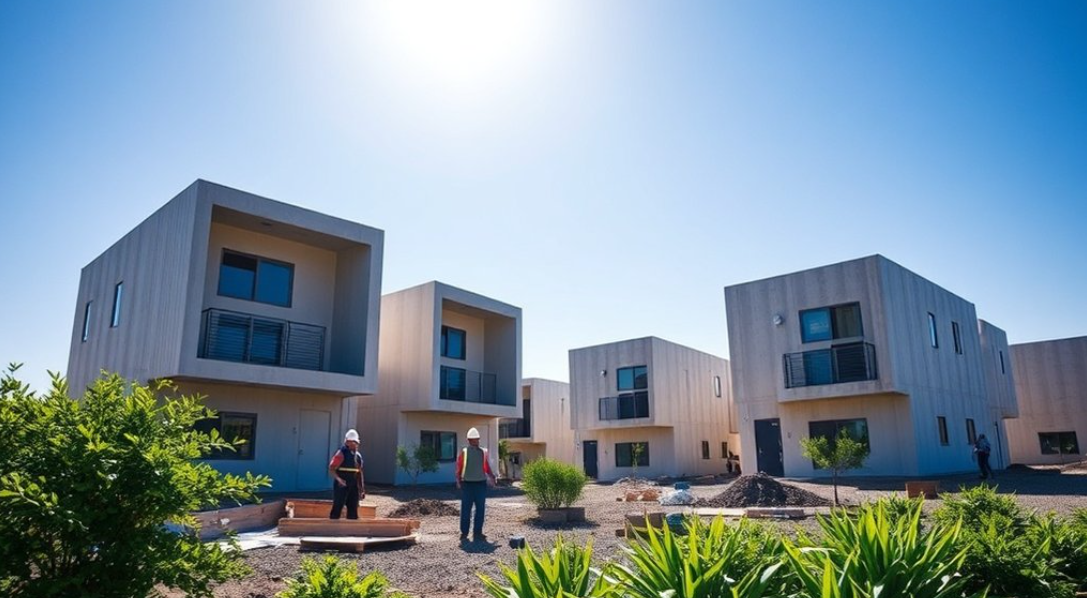
The Cost Benefits of Modular Precast/GFRC Housing
Upfront Cost: Lower When You Account for Lifecycle
GFRC and precast modular units carry lower upfront cost than comparable shipping container or stick-built options — and dramatically lower lifecycle cost:
- No rust, no rot, no termite damage, no warping: GFRC panels are inorganic. Unlike steel shipping containers or wood-frame construction, GFRC does not corrode, rot, or attract pests. Service life: 50+ years (aligned with ASTM C150, C144, and C1116/C1116M standards).
- Non-combustible: GFRC meets ASTM E136 for non-combustibility — critical in wildfire-prone regions like California, Arizona, and Texas.
- 60% lower environmental impact than traditional precast concrete (UK DETR/Concrete Industry Alliance study), reducing embodied carbon per deployment.
FEMA-Eligible Construction = Faster Grant Approval
ASTM standards compliance (C150 for cement, C144 for sand aggregates, C1116/C1116M for fiber-reinforced concrete) means modular GFRC units meet FEMA’s quality thresholds for disaster housing procurement. The March 2024 FEMA guidelines explicitly incorporate modular building standards — removing a key barrier that previously stalled grant approvals.
Panelized Shipping: Eliminating the Container Freight Trap
Shipping containers have a brutal hidden cost: freight. A 40-foot container with a single-module dwelling can run $15,000–$25,000 in transportation to a disaster site.
Panelized GFRC units ship compact. Flat-packed wall and floor panels dramatically reduce per-unit freight costs and allow deployment to remote or logistically constrained sites — something shipping containers cannot do.
Long-Term ROI: Reuse Across Multiple Disaster Cycles
The single greatest argument for modular GFRC over shipping containers: redeployability.
- Panelized GFRC panels disassemble and relocate to new sites after initial deployment
- Pre-staged regional inventory allows deployment within 72 hours of a disaster declaration
- Salvage value: GFRC panels retain material value; containers become scrap
- A single inventory of 50 units, cycled across 10 disaster deployments over 25 years, generates dramatically more value than 50 single-use shipping containers
Funding Models That Apply
Modular precast and GFRC shelters qualify for:
| Funding Source | Applicable Use | Notes |
|---|---|---|
| FEMA Disaster Relief Grants | Temporary/permanent post-disaster housing | March 2024 guidelines open to modular manufacturers |
| HUD CDBG | Affordable housing, homeless shelters | CDBG-CV funds available post-COVID |
| HUD Homekey (California) | Adaptive reuse and modular | Avg. $144K/unit — cities favor modular approaches |
| State Affordable Housing Funds | Permanent supportive housing | Modular reduces per-unit cost to competitive levels |
| Public-Private Partnerships | Mixed homeless + disaster resilience | Municipalities co-fund units as dual-use assets |
| Insurance Recovery Proceeds | Post-disaster permanent replacement | Precast = faster occupancy than site-built |
Finish & Modification: Built to Expand
Staged Utility Installation
One of the most underappreciated advantages of modular GFRC housing: the shell comes first.
Base panels ship and assemble quickly — foundations can be minimal depending on site conditions. Utilities (running water, electrical, HVAC) are installed incrementally as budget allows. This is not a compromise — it’s smart phasing.
Traditional stick-built construction requires all utilities to be roughed in before the structure is weather-tight. Modular GFRC allows occupancy of the shell while final MEP systems are completed in phases — dramatically reducing time-to-occupancy.
Upgradable Systems
Electrical, plumbing, and HVAC systems in modular GFRC units are designed for modification. Unlike shipping containers, where utilities are welded and integrated into the structural shell, GFRC modular units allow systems to be updated, expanded, or replaced without structural modification.
Architectural Flexibility — Not a Box
GFRC panels can be finished with virtually any cladding: stone facades, stucco, wood siding, metal panels. The base structure adapts to existing neighborhood aesthetics rather than imposing a uniform visual identity. This matters enormously for community acceptance — a persistent barrier to homeless housing projects in residential areas.
ADA Compliance Built Into Spec
Modular GFRC units designed to HUD’s Accessible Design Guidelines meet ADA requirements from the start — not as a retrofit. Door widths, turning radii, grab bar reinforcement, threshold heights, and accessible fixture placement are engineered into the panel specification before fabrication. This eliminates the retrofit cost that adds $15,000–$30,000 per unit to traditional accessible housing.
Portability: Not a One-Time Fix
Shipping containers arrive and stay. Traditional modular units (wood-frame) are rarely relocatable after initial installation. FEMA trailers serve 18 months and are decommissioned.
GFRC panelized units break this pattern:
- Panelized GFRC panels disassemble and relocate to new sites
- Pre-staged inventory model: Units stored regionally, deployed within 72 hours of a disaster declaration
- Reuse across multiple disaster cycles: A single inventory investment pays dividends across decades of deployments
- Salvage value: GFRC panels retain material value at end of service life — unlike steel shipping containers that become scrap
After the 2018 Camp Fire, 1,200 container homes proved 40% more energy-efficient than FEMA trailers (UC Berkeley study). But container homes stayed — they couldn’t be redeployed. GFRC modular units avoid that trap entirely.
Key Takeaway: The housing crisis in disaster zones and homeless populations is not a supply problem — it’s a delivery mechanism problem. The same budget that produces a $837,000 traditional unit could fund 10–15 modular GFRC units with full ADA compliance, reusability across disaster cycles, and a 50+ year service life.
- Deploy in 72 hours vs. months for traditional construction
- Reuse across multiple disaster cycles — containers cannot do this
- 50+ year service life vs. 20–25 years for shipping containers
- ASTM-compliant = FEMA-eligible for faster grant approval
Conclusion
The math on traditional homeless housing and disaster relief shelters has been broken for decades. Modular GFRC units — built to ASTM standards, deployable in 72 hours, reusable across disaster cycles, and eligible for FEMA/HUD funding — offer a structurally different solution that the data supports at every level.
Whether you’re a city planner managing homeless housing, a FEMA contractor sourcing rapid-deployment units, or a developer building permanent supportive housing with CDBG funding, Mesa Precast has the manufacturing capability and specification expertise to deliver.