Institutional buildings are expected to outlast everyone who designs them. A university library built today should still read as authoritative in 2125. A courthouse must project permanence from day one. A hospital campus must convey trust before a patient even walks through the door. That requirement — lasting architectural gravity — is why campuses and institutions across Texas, Arizona, Florida, Colorado, Louisiana, Georgia, Alabama, Southern California, Utah, and New Mexico consistently specify cast stone.
Cast stone delivers the visual language of traditional masonry — columns, cornices, banding, balustrades, arched openings — at a fraction of the cost and lead time of natural limestone or granite. For an institution specifying fifty identical column capitals for a library colonnade, or 1,250 custom facade panels for a state museum, the economics are decisive. And unlike natural stone, cast stone is manufactured to tolerances: every unit ships to exact dimension, consistent color, and repeatable profile.
This article walks through the real institutional and campus-scale projects Mesa Precast has completed — from a Texas university to an APA Award-winning business park to a children's hospital — and explains exactly how architects spec cast stone for institutional work.
Why Institutions Choose Cast Stone

Cast stone's consistent quality and precision manufacturing make it the material of choice for institutional clients who need every element to match — from the first building to future phases decades later.
Permanence
Cast stone, manufactured to ASTM C1364 standards, achieves compressive strengths of 6,500 psi and above. At institutional scale — where a building is expected to serve for 75 to 100+ years — that durability is non-negotiable. Properly sealed and detailed cast stone facades perform comparably to natural limestone at a fraction of the replacement and maintenance cost. Institutions in coastal Florida and Alabama benefit particularly from cast stone's resistance to salt air degradation versus steel-reinforced or unstabilized masonry alternatives.
Prestige Through Architectural Language
Classical architectural vocabulary — columns, entablatures, cornices, keystones — communicates institutional authority across cultures and centuries. A cast stone library building in Texas or a precast concrete campus architecture project in Colorado uses these elements to anchor a facility in a tradition of learning, governance, or healing. Cast stone allows architects to specify this language at institutional volumes — hundreds of identical units — without the cost of hand-carved natural stone or the inconsistency of field fabrication.
Design Flexibility at Scale
Mesa Precast's custom mold-making capability means any profile can be produced. If the design calls for a custom cornice with a 7-inch projection and a specific ogee profile that matches an existing building, Mesa can fabricate the mold and cast as many units as the project requires — all identical. For campus expansion projects in Southern California and Arizona, matching existing historic fabric is as important as designing the new facade: cast stone's manufacturing precision makes contextual matching achievable where natural stone sourcing is not.
Cost Efficiency at Institutional Scale
The economics of cast stone improve dramatically at scale. For a university campus architecture project requiring 200 column caps, 500 linear feet of banding, and 80 window sills, the unit cost per piece — once molds are amortized — becomes highly competitive with precast concrete alternatives that lack the design detail cast stone can achieve. For healthcare facilities in Florida, Georgia, and Alabama working with tight capital budgets, cast stone delivers natural stone aesthetics at 50–70% of natural stone cost.
Key takeaway: Institutions choose cast stone because they need permanence, prestige, and design precision at high unit volumes — all three properties that natural stone cannot deliver economically at scale, and that undifferentiated precast concrete cannot deliver aesthetically.
Product Applications at Institutional Scale
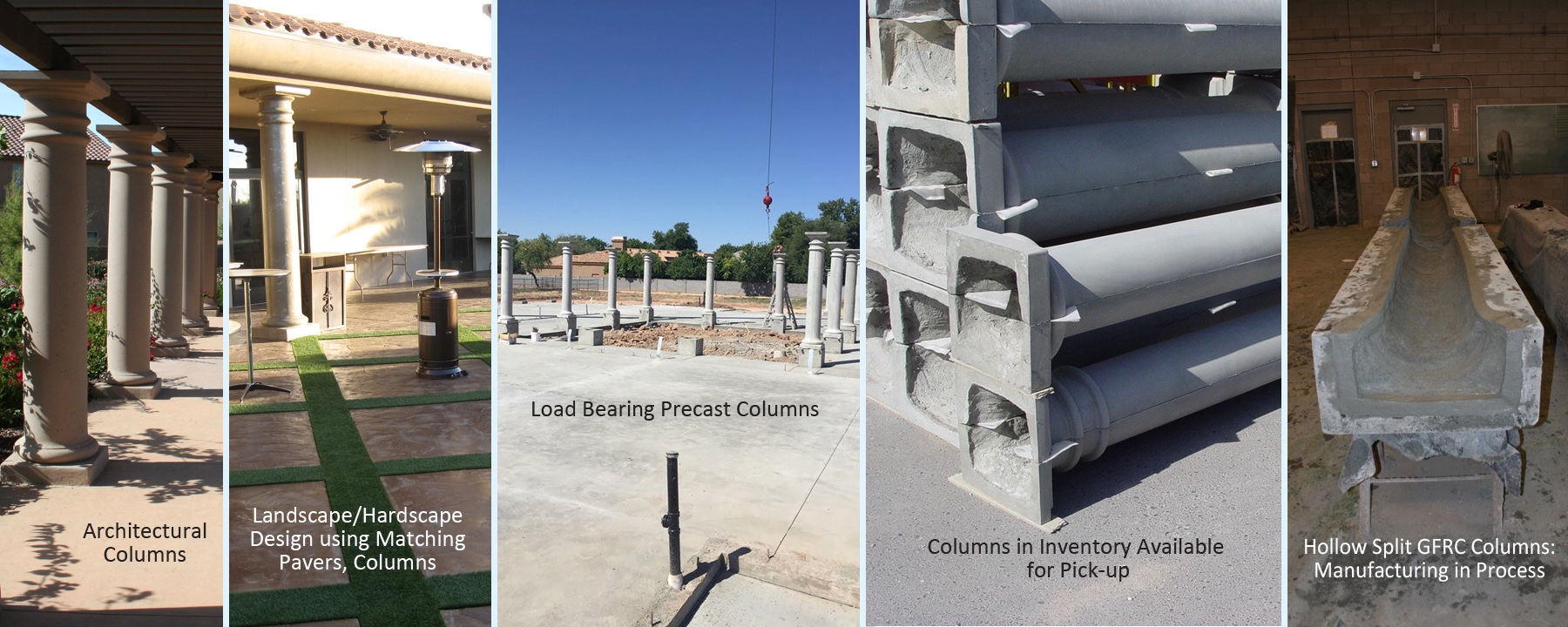
Columns, pilasters, and colonnades are defining elements of institutional architecture. Mesa Precast produces all classical orders in both cast stone and GFRC — engineered for anchor requirements in large institutional buildings.
Institutional and campus-scale projects use cast stone across a broader range of applications than residential work. The following product categories are the most common at universities, libraries, courthouses, hospitals, and business parks:
| Product | Typical Application | Institutional Use Case |
|---|---|---|
| Columns & Column Capitals | Entry colonnades, covered walkways, porticos | Libraries, courthouses, university entrance facades |
| Wall Caps | Parapet caps, retaining wall caps, garden walls | Campus perimeter walls, courtyard planting beds, site signage bases |
| Banding & Belt Courses | Horizontal emphasis at floor lines, string courses | Facade articulation on multi-story campus buildings |
| Cornices | Crowning facade element at roof line | Classical and Collegiate Gothic institutional buildings |
| Domes & Dome Segments | Entry pavilion domes, portico rooftop elements | Business parks, courthouse entries, hospital chapel spaces |
| Balustrades | Terrace railings, stair railings, parapet balustrades | Campus quadrangles, elevated walkways, entry stairs |
| Signage Elements | Campus entry signs, building identification panels | University campus identifiers, hospital main entries |
| Archways & Arch Voussoirs | Entry arches, arcade openings, window surrounds | Campus gateways, library reading room windows |
| Custom Facade Panels | Large-format cladding, rain screen panels | Museums, performing arts buildings, contemporary campus buildings |
| Sills & Lintels | Window sills, door lintels, opening trim | Standard across all institutional building types |
Case Study: Colin Library — Cast Stone Columns, Wall Caps, Banding & Cornices
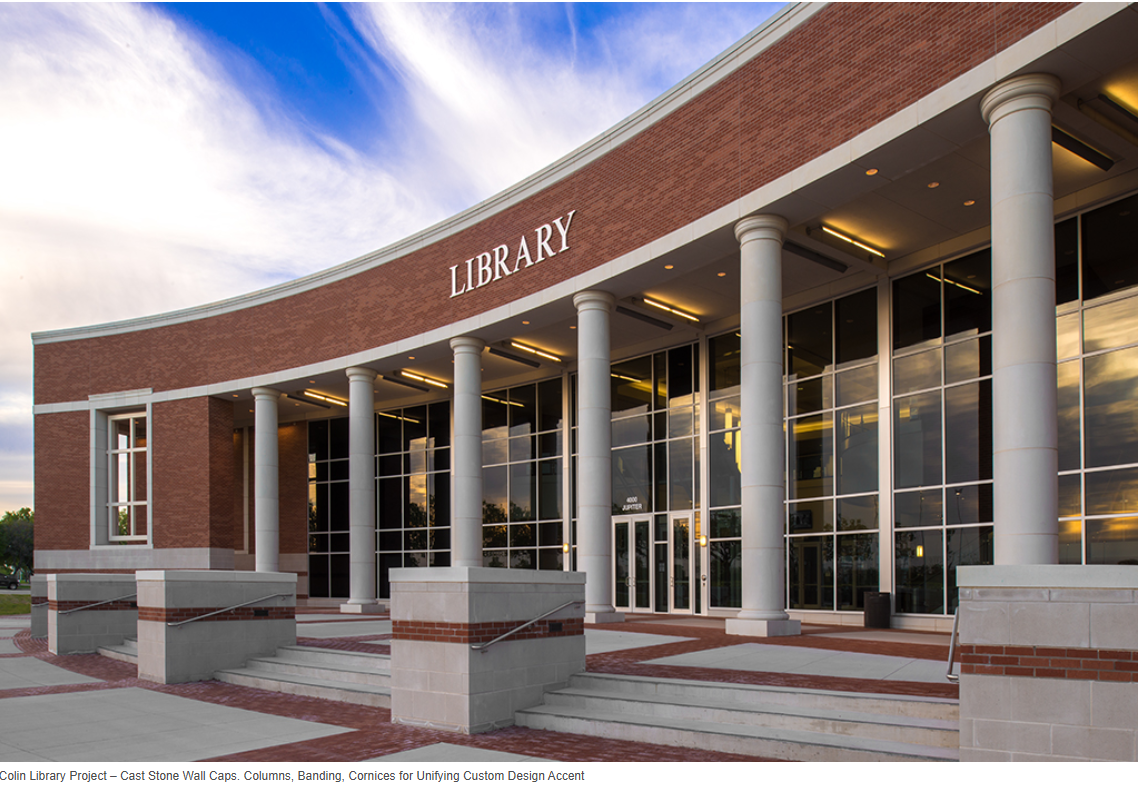
Colin Library, featuring Mesa Precast cast stone columns, wall caps, horizontal banding, and cornice detailing. The classical vocabulary unifies the building's facade and establishes the institutional character expected of a major academic library.
Colin Library
A comprehensive cast stone program — columns anchoring the main entry colonnade, wall caps finishing campus perimeter elements, horizontal banding coursing the facade at floor lines, and a detailed cornice crowning the building at roofline. Every element manufactured by Mesa Precast, providing consistent color, texture, and profile throughout.
The Colin Library project illustrates the full institutional cast stone vocabulary. Entry columns are the most visible element — their scale, profile, and finish set the tone for the entire building and communicate the library's civic purpose. Mesa Precast fabricated the column shafts, bases, and capitals to exact specification, ensuring consistent diameter, taper, and capital profile across all units in the colonnade.
Horizontal banding serves a dual function: it articulates the facade by marking floor levels and creates visual scale appropriate to an institutional building. Without banding, multi-story institutional facades can read as undifferentiated walls; the banding course breaks the mass and ties the composition together. For a cast stone library building, horizontal emphasis also connects the facade to classical precedent — the tripartite division of base, shaft, and entablature that has organized institutional buildings since ancient Greece.
Wall caps and cornices complete the facade's upper termination. The cornice at Colin Library provides the proper top edge to the building — a projecting horizontal element that throws water clear of the facade and signals, compositionally, that the building has a proper crown. Together, columns, banding, wall caps, and cornices define the complete cast stone institutional toolkit. For campuses in Texas, Colorado, Georgia, and Florida seeking to maintain architectural coherence across multiple buildings, this toolkit provides the consistent language a campus master plan requires.
Planning a campus building? Get budgetary pricing on institutional cast stone products — columns, banding, cornices, and wall caps.
Use the Estimator →Case Study: Old Parkland West Business Park — 2016 APA Award Winner
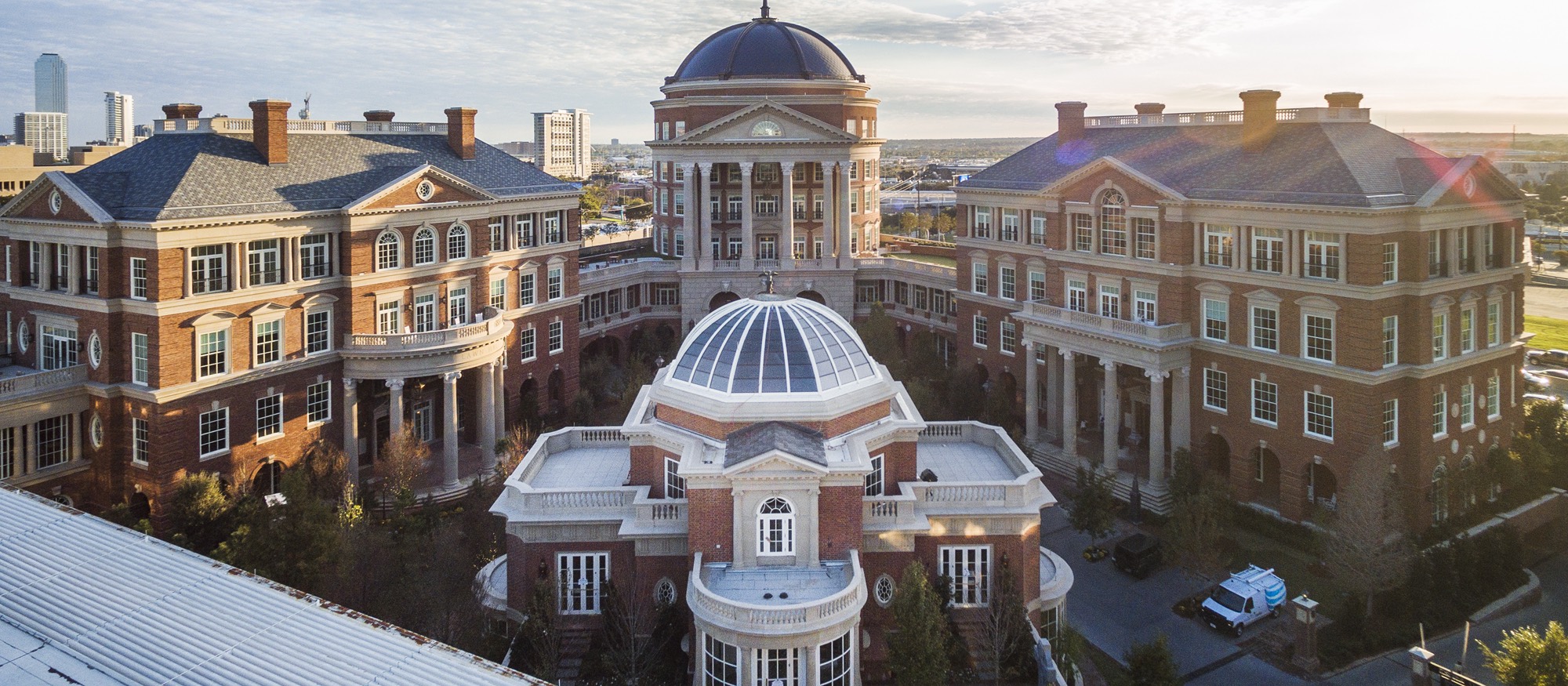
Old Parkland West Business Park, winner of the 2016 Architectural Precast Association (APA) Award of Excellence. The project features Mesa Precast cast stone domes, columns, and balustrades — among the most complex institutional cast stone assemblies in the region.
Old Parkland West Business Park
Recognized by the Architectural Precast Association for outstanding design and manufacturing quality. Old Parkland West features one of the most complete cast stone programs Mesa Precast has executed for a commercial campus — including complex dome fabrication, full classical column assemblies, and balustrade systems at scale.
The APA Award of Excellence is the industry's highest recognition for architectural precast. Old Parkland West Business Park earned it in 2016 for a cast stone program that set a standard for commercial precast architecture in Texas — and demonstrated that business park design could achieve institutional-grade quality without institutional budgets.
Dome Fabrication
Domes represent the most demanding cast stone application from a manufacturing standpoint. Each dome segment must be dimensionally precise — errors accumulate across segments and prevent proper assembly. Mesa Precast fabricated the dome segments for Old Parkland West using precision formwork calibrated to the dome's exact radius, producing segments that assembled cleanly without shimming or field modification. For commercial precast columns in Arizona, Colorado, and New Mexico where classical business park design has seen a revival, dome elements are increasingly requested as entry pavilion features — and Mesa Precast's demonstrated capability on this project is the reference specification teams reach for.
Balustrades at Campus Scale
Balustrade systems — balusters, rails, newel posts — require high unit counts and absolute dimensional consistency. A single balustrade run of 50 feet may require 80+ individual balusters; any variation in turning profile or height creates visible inconsistency. Mesa Precast's baluster casting program for Old Parkland West produced perfectly uniform units at the volumes the project required. For business parks and campus development in Texas, Louisiana, and Florida where classical balustrade detailing defines the landscape perimeter, this kind of manufacturing consistency is the difference between a project that reads as quality and one that reads as cheap imitation.
Why the APA award matters for specifiers: The Architectural Precast Association evaluates submitted projects on design intent, manufacturing quality, and installation coordination. An APA Award of Excellence is peer validation from the precast industry that the manufacturer and architect achieved something exceptional — not just marketed it as such. For institutional project committees in Texas, Arizona, Florida, and Georgia evaluating manufacturers, APA recognition is a shorthand quality signal that bypasses the need for extended reference checks.
Case Study: Texas State University — Campus Signage, Wall Caps & Institutional Facade
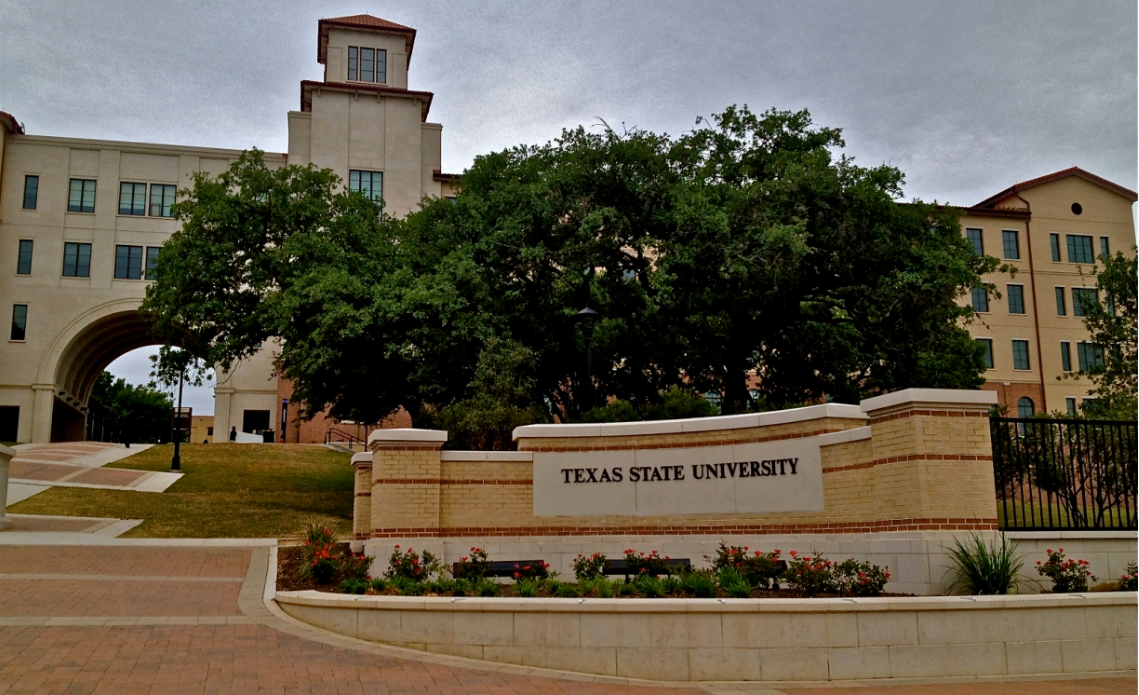
Texas State University campus — Mesa Precast cast stone campus signage elements, wall caps, and institutional facade detailing. Cast stone at a major Texas university campus, where material consistency and durability across a large footprint are essential.
Texas State University
Cast stone for a major Texas public university — campus signage elements in cast stone that anchor entry points and building identifications, wall caps that finish campus perimeter and courtyard walls, and institutional facade elements that integrate with the broader campus architectural vocabulary.
Campus signage in cast stone is a commitment to permanence. Unlike painted metal or fabricated letters, a cast stone entry monument or building identifier becomes part of the campus fabric — weathering gracefully and reading as institution rather than afterthought. Texas State University's cast stone signage elements establish the same visual language as the buildings themselves, creating continuity between architecture and landscape.
Cast stone university campus projects in Texas present a specific design challenge: the Hill Country aesthetic that characterizes San Marcos and similar campuses calls for warm limestone tones and traditional masonry profiles that connect to the regional vernacular. Cast stone matches this requirement precisely — Mesa Precast's color matching capability allows a new building's cast stone to blend with existing limestone campus buildings, maintaining the visual consistency that campus master plans require.
For architectural precast institutional projects across Texas — from UT Austin to Texas A&M to regional universities in Lubbock, Denton, and Nacogdoches — Mesa Precast's proximity and experience with Texas campus architectural standards makes specification straightforward. Standard campus details (wall cap profiles, sill dimensions, column diameters) developed for one project can often be reused at the next, reducing design time and maintaining campus material coherence.
Large-Scale Proof: Louisiana State Museum, Sports Hall of Fame & Beyond
Mesa Precast's institutional portfolio extends well beyond Texas. Several projects demonstrate manufacturing capability at a scale that qualifies Mesa for the most ambitious institutional programs:
Louisiana State Museum — 1,250 Custom Cast Stone Panels
Working with Trahan Architects, Mesa Precast fabricated 1,250 custom cast stone panels for the Louisiana State Museum — one of the largest custom cast stone programs in the region's history. Each panel required dimensional precision and surface quality appropriate for a major cultural institution. The project established Mesa Precast's capacity for high-volume custom panel work and demonstrated the coordination capabilities required for a project of museum-grade complexity. For institutional specifiers in Louisiana, Alabama, Georgia, and Florida evaluating cast stone manufacturers for museum, cultural center, or government building projects, the Louisiana State Museum reference represents the relevant proof of scale.
Louisiana Sports Hall of Fame
Another Louisiana cultural institution in Mesa Precast's portfolio, the Sports Hall of Fame required cast stone work befitting a permanent public cultural landmark. Like the State Museum project, it demanded both manufacturing volume and the quality consistency expected of publicly visible, publicly funded institutional architecture.
Rockwall Courthouse — Texas Institutional Precedent
The Rockwall Courthouse demonstrates Mesa Precast's work on civic and governmental architecture in Texas — a building type that demands institutional gravitas in every detail. Courthouse design carries specific requirements: materials and profiles must communicate permanence and authority, and any quality inconsistency reads as disrespect for the institution the building represents. Mesa Precast's cast stone program for the Rockwall Courthouse meets that standard.
Gilbert Christian HS — Educational Campus Precedent
For cast stone in Arizona educational settings, the Gilbert Christian High School project demonstrates Mesa Precast's work in the Southwest market. Educational campuses in Arizona share many of the same cast stone specification needs as universities: campus signage, wall caps, banding, and entry elements that establish institutional character while meeting the durability requirements of a high-traffic student population.
Large institutional project? Our team handles high-volume custom programs. Share your drawings for a project-specific consultation.
Request a Quote →Healthcare Architecture: Cast Stone for Hospitals & Medical Campuses
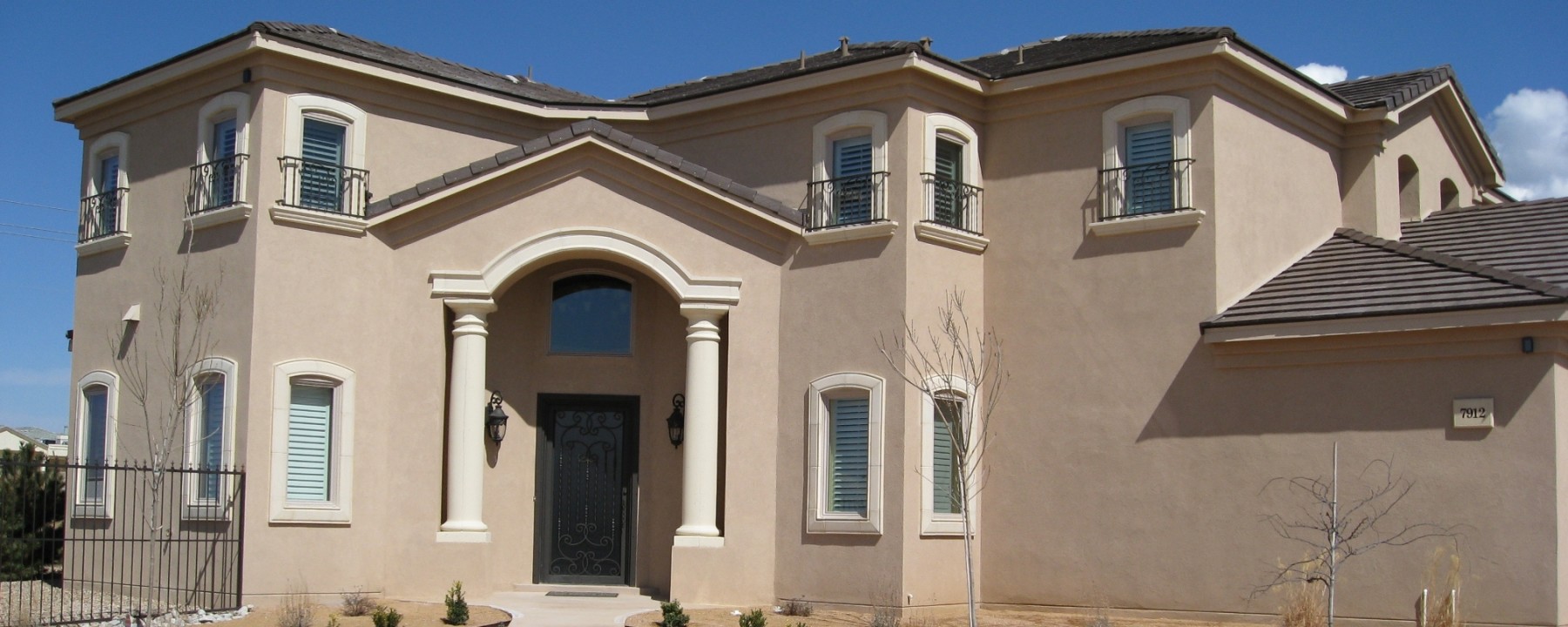
Color matching is critical on healthcare campuses — new wings must match existing buildings that may be 20–50 years old. Mesa Precast's batch control produces sample boards with 3–5 color options until you find the exact match.
Healthcare architecture has its own set of demands that make cast stone a particularly strong fit. Hospitals and medical campuses must balance clinical functionality with an environment that reduces patient anxiety, communicates competence, and projects institutional trust. The exterior facade sets that expectation before the patient enters.
Why Healthcare Campuses Specify Cast Stone
| Requirement | Why Cast Stone Meets It | Alternative Limitation |
|---|---|---|
| Timeless Aesthetic | Classical profiles never read as dated; a hospital built in 1950 with cast stone columns still reads as credible today | Trend-driven cladding materials date quickly, triggering expensive facade refreshes |
| Durability | 6,500+ psi compressive strength; resists the constant foot traffic, maintenance vehicle contact, and weather cycling of a large medical campus | Softer natural stones chip and stain; EIFS degrades in high-traffic zones |
| Low Maintenance | Cast stone requires minimal maintenance — periodic cleaning and joint repointing; no annual sealing, no specialized stone care | Natural stone requires ongoing sealing and specialty maintenance programs |
| Patient-Centered Design | Classical proportions and natural material tones create a calming environment; cast stone's warm limestone palette reads as humane rather than institutional | Plain precast concrete reads as clinical; metal panel systems read as industrial |
| Campus Cohesion | Medical campuses expand over decades; cast stone's manufacturability ensures new buildings match the original facade color and profile exactly | Natural stone from different quarries never matches; older natural stone buildings are effectively irreproducible |
Cook Children’s Hospital — Mesa Precast Healthcare Reference
Cook Children's Hospital in Fort Worth, Texas is a flagship Mesa Precast healthcare project. A pediatric hospital presents particular design challenges: the exterior must communicate trust and permanence to anxious parents while creating an environment that feels welcoming rather than intimidating. Cast stone for hospital facades in Texas accomplishes this through warm material tones, classical proportions, and the visual solidity that communicates "this building was built to last."
For children's hospital architectural stone applications, the warm limestone palette of cast stone is specifically effective: it reads as nurturing rather than clinical, connecting the building to traditional institutional design rather than the sterile aesthetic of purely functional healthcare construction. Mesa Precast's work at Cook Children's demonstrates that cast stone hospital facades serve both the functional durability requirements and the patient-centered design goals of modern healthcare architecture.
Healthcare Cast Stone Applications by Region
Hospital precast facade in Arizona: Desert climate performance is a primary concern — extreme UV exposure, significant thermal cycling between day and night, and minimal precipitation all favor cast stone over materials that require moisture for proper performance. Mesa Precast's cast stone is manufactured for dry climate performance, making it the specification of choice for medical center cast stone in Southern California and Arizona.
Healthcare facility precast in Florida: Florida's coastal humidity, salt air, and hurricane wind loads require a material that can handle sustained moisture exposure without degradation. Cast stone manufactured to ASTM C1364 with properly placed reinforcement performs well in Florida's coastal healthcare environment. Hospital facade design in Georgia and healthcare building stone in Alabama face similar humid climate requirements, where cast stone's density and low absorption rate provide the durability institutional clients demand.
Medical campus cast stone in Texas: Texas healthcare campuses — particularly the major medical complexes in Houston, Dallas, and San Antonio — are among the most active institutional construction markets in the country. The scale of Texas medical campus development aligns with Mesa Precast's manufacturing capacity: large programs with high unit volumes are exactly where cast stone's economics become decisive versus natural stone alternatives.
Specifying cast stone for a healthcare project? Mesa Precast provides product submittals, samples, and budgetary pricing for hospital and medical campus projects. Reference Cook Children's Hospital for Ft. Worth Texas healthcare precedent; Louisiana State Museum (1,250 panels) for large-scale custom program capacity.
How Architects Specify Cast Stone for Institutional Projects
CSI MasterFormat Section
Cast stone for institutional projects is specified under CSI MasterFormat Division 04 — Masonry, Section 04 72 00 — Cast Stone Masonry. The specification section should reference ASTM C1364 (Standard Specification for Architectural Cast Stone) as the governing standard for material properties, and should define:
- Compressive strength minimum (typically 6,500 psi for institutional applications)
- Water absorption maximum (typically 6% by ASTM C1585)
- Color and finish requirements (with approved sample standard)
- Dimensional tolerances (per ASTM C1364)
- Reinforcement requirements for long-span units
- Anchoring and connection details (masonry ties, dowels, shelf angles)
Approved Manufacturers List
For institutional projects — especially publicly funded buildings in Texas, Louisiana, Florida, Georgia, and Arizona — the specification typically includes an approved manufacturers list. Mesa Precast qualifies for approved manufacturers lists based on CSI membership, ASTM compliance, and demonstrated project portfolio. The Old Parkland West APA Award and the Louisiana State Museum 1,250-panel program are the reference projects most commonly cited in approved manufacturer submissions for large institutional programs.
Shop Drawing & Sample Approval Process
Institutional cast stone projects require a formal shop drawing and sample approval process:
- Bidding: Architect provides cast stone schedule with all unit types, profiles, quantities, and finish requirements
- Shop drawings: Mesa Precast submits dimensioned shop drawings for each unit type; architect reviews for compliance with contract documents
- Sample approval: Pre-production samples submitted for color, texture, and finish approval; approved samples become the contractual standard for production
- Production: Units manufactured per approved shop drawings and samples
- Inspection: Quality control review; architect or owner representative may inspect at plant prior to delivery
Coordination with Other Trades
On institutional projects, cast stone installation requires coordination with structural steel (for shelf angles and lintels), masonry (for coursing and joint alignment), and waterproofing. Mesa Precast's project management team manages this coordination on large campus programs — the Louisiana State Museum's 1,250-panel program and the Old Parkland West APA Award project both required multi-trade coordination that Mesa Precast managed from the precasting side.
Mesa Precast’s Industry Awards: CSI, APA, MCAA
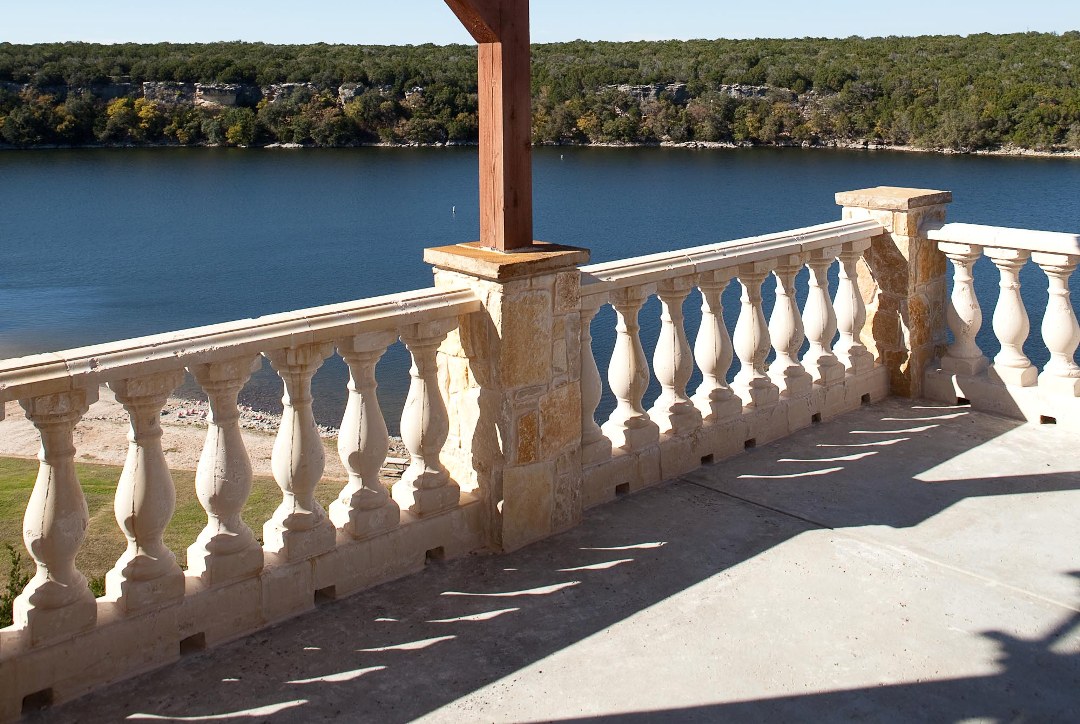
Mesa Precast operates plants in Texas, Arizona, and Pennsylvania — providing institutional project teams with reliable manufacturing capacity, consistent quality control, and regional delivery.
For institutional project specifiers, manufacturer awards and industry recognition are meaningful signals — they represent peer evaluation rather than marketing claims. Mesa Precast holds recognition from three of the construction industry's most respected organizations:
APA — Architectural Precast Association
The APA Award of Excellence (2016, Old Parkland West Business Park) is the precast industry's highest design and manufacturing honor. APA evaluates projects on design intent, engineering achievement, and installation quality. The award signals to specifiers that Mesa Precast has achieved exceptional results on a complex institutional program under real project conditions.
CSI — Construction Specifications Institute
CSI membership and recognition is relevant for architects specifying cast stone under MasterFormat Division 04. CSI-affiliated manufacturers are familiar with proper specification language, submittal requirements, and the coordination protocols that institutional projects demand. For institutional stone facade projects in Florida, Georgia, and Alabama, CSI compliance is often a pre-qualification requirement for public projects.
MCAA — Mason Contractors Association of America
MCAA recognition reflects quality in the masonry installation trade — relevant for institutional projects where cast stone is installed as part of a broader masonry program. For campus buildings in Colorado, Utah, and New Mexico where cast stone integrates with traditional masonry construction, MCAA-quality installation coordination ensures the full assembly performs as designed.
For institutional project committees: Mesa Precast's combination of APA, CSI, and MCAA recognition represents the broadest industry quality validation available in the architectural cast stone category. Request reference project documentation for any of the projects mentioned in this article as part of your manufacturer qualification process.
Ready to Specify Cast Stone for Your Institutional Project?
Campuses, libraries, hospitals, courthouses, and business parks across Texas, Arizona, Florida, Colorado, Louisiana, and the Southwest. Get budgetary pricing in 48 hours — or start with the online estimator.
Use the Estimator → Request a Quote →