The fireplace is the defining focal point of any room. In luxury homes across Arizona, Texas, Florida, Southern California, Colorado, Utah, New Mexico, Louisiana, Alabama, and Georgia, architects and interior designers are specifying cast stone and GFRC fireplace surrounds in record numbers — for one simple reason: they can get exactly what they envision, faster and at a fraction of the cost of natural stone.
Classical? A cast stone mantel with full Corinthian pilasters, carved acanthus leaf capitals, dentil molding, and a hand-detailed overmantel panel. Contemporary? A GFRC fire feature with clean geometric reveals, an ultra-thin profile, and a matte concrete finish. Both come from the same manufacturer. Both ship in 8–12 weeks. Neither requires quarrying, cutting, or the structural reinforcement natural limestone demands.
This guide covers both ends of the design spectrum — and explains why cast stone and GFRC are the smart material choice for fireplace surrounds, whether the project is an interior great room or an outdoor living space in Scottsdale, Fort Worth, or Miami.
Why Cast Stone & GFRC Beat Natural Stone for Fireplaces
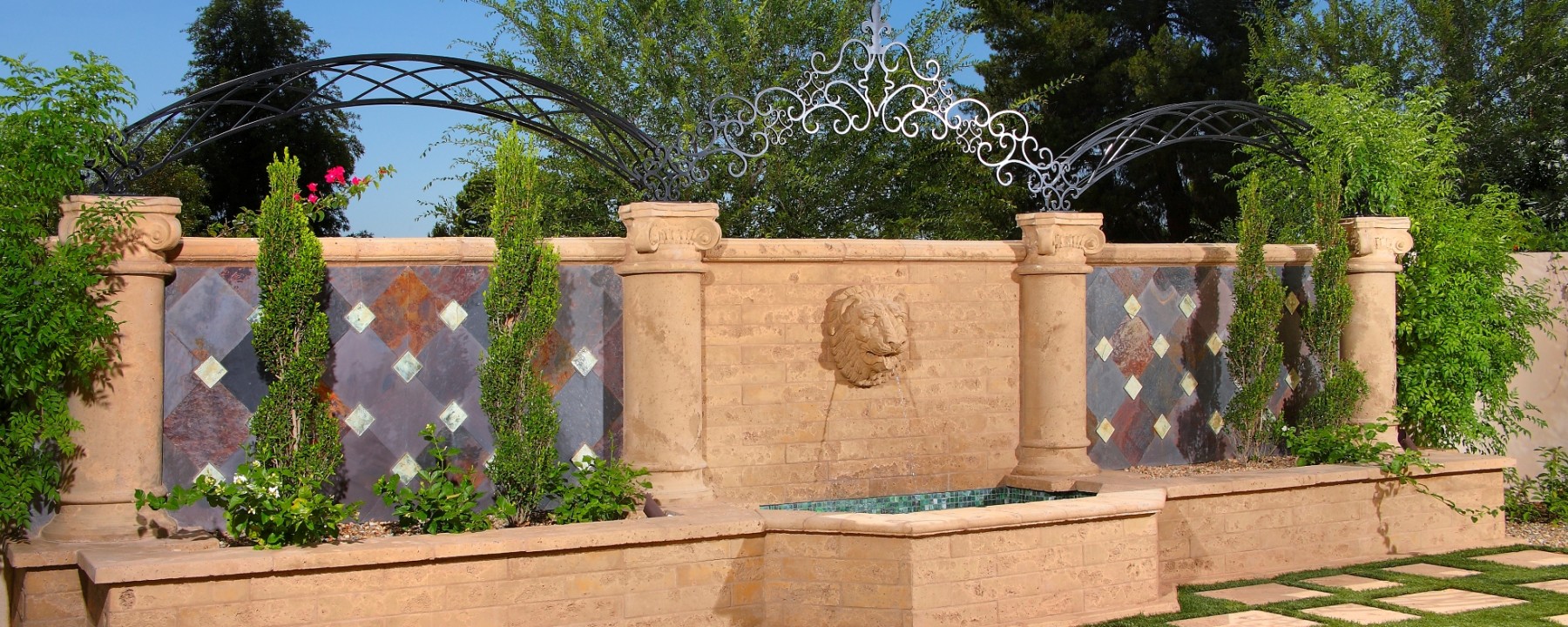
Cast stone and GFRC fireplace surrounds cost 40–60% less than equivalent natural stone while matching it visually. Lighter weight reduces structural requirements, and custom molds enable any profile from Gothic to ultra-modern.
Natural limestone and marble are beautiful. They're also heavy, expensive, slow, and unforgiving when it comes to custom profiles. Cast stone and GFRC (Glass Fiber Reinforced Concrete) solve every one of those problems without sacrificing aesthetics.
Cost
A custom carved natural limestone mantel with classical detailing — columns, capitals, overmantel panel — runs $18,000 to $45,000+ depending on complexity and sourcing. An equivalent cast stone mantel from Mesa Precast comes in at $4,500 to $12,000, including custom profiles. That difference pays for landscaping, cabinetry, or half a kitchen.
Weight
Natural limestone fireplace surrounds weigh 800–1,400 lbs for a full classical assembly. Cast stone runs 60–75% lighter for the same visual mass. This matters enormously in two situations: upper-floor installations (structural load calculations change significantly) and outdoor installations (footings, post tensioning, and site access all simplify with lighter material).
Customization
Natural stone carvers are rare, expensive, and booked months out. With cast stone, a custom profile means building a form. Mesa Precast fabricates custom molds in-house — a new capital profile, a unique overmantel shape, a site-specific arch radius. Once the mold exists, it can cast dozens of identical units with perfect consistency. For natural stone, every piece carved by hand introduces variation.
Lead Time
Custom cast stone and GFRC fireplace surrounds typically ship in 8–12 weeks from approved shop drawings. Custom carved natural stone: 16–30+ weeks, often imported from Italy or China with all the logistics and quality-control uncertainty that entails.
Key takeaway: For custom fireplace surrounds, cast stone and GFRC deliver the same visual result as natural stone — at 40–60% lower cost, 75% less weight, and twice the speed. The only reason to choose natural stone for a fireplace is if the client specifically wants material authenticity at close-range touch points. Even then, the hybrid approach (natural stone cap, cast stone surround) is common.
Classical Ornate Fireplace Surrounds
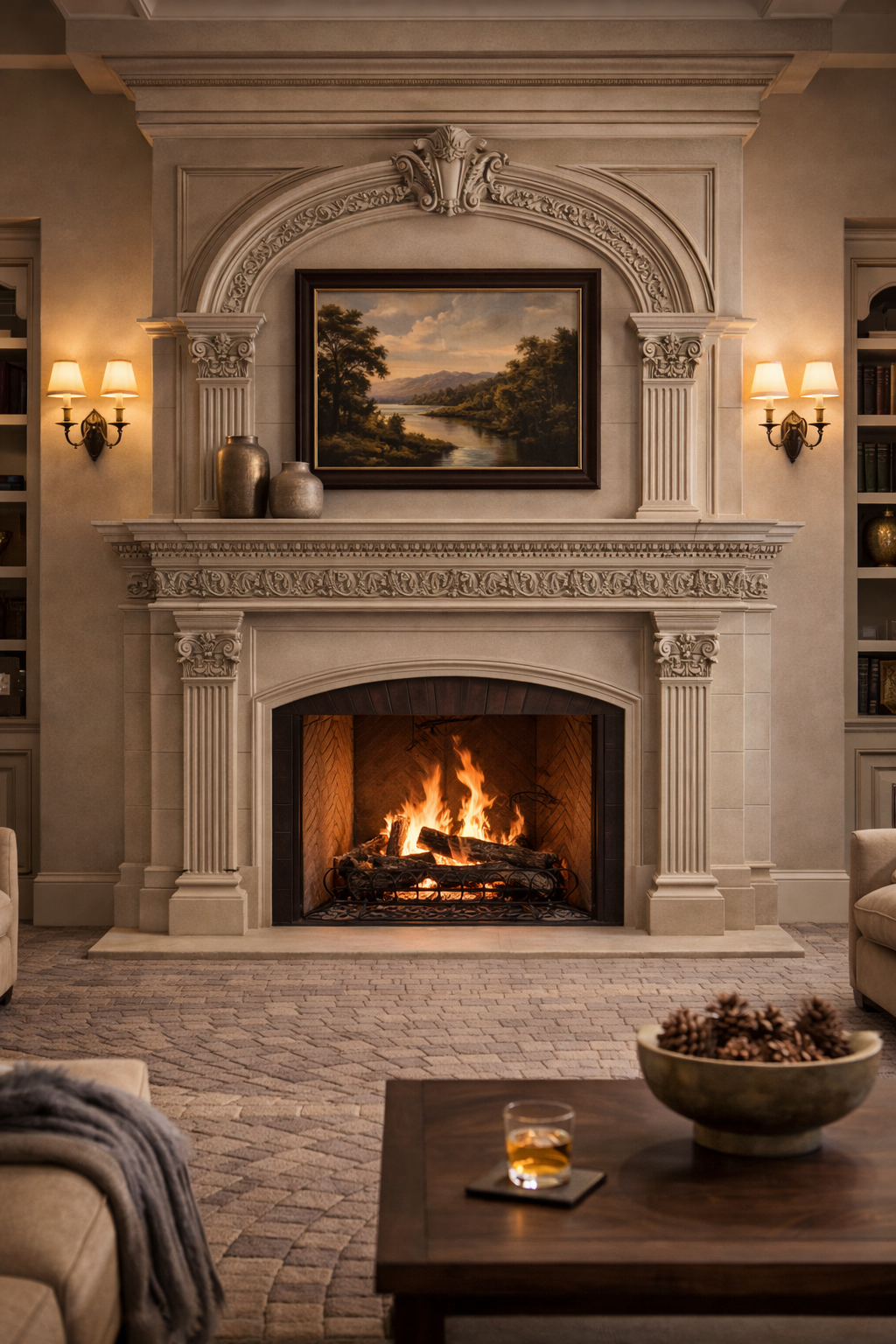
Classical cast stone fireplace surround with full pilaster columns, carved capitals, and detailed overmantel panel. Manufactured by Mesa Precast.
Classical fireplace design draws from centuries of European architectural tradition: Roman, Georgian, Federal, and French Baroque influences that never go out of style in luxury residential design. A proper classical surround is an architectural statement — it anchors a room, sets a scale, and communicates craftsmanship.
The challenge has always been cost. Hand-carved limestone or marble in classical profiles requires skilled stone carvers working slowly and precisely. Cast stone changes the economics entirely: the labor-intensive work happens once, in mold fabrication. After that, the profiles cast consistently and economically.
Classical Profile Elements Mesa Precast Manufactures
- Pilasters and full columns — Tuscan, Doric, Ionic, Corinthian, Composite orders; any shaft diameter, entasis, and capital profile
- Dentil molding — Single and double courses, any tooth size and spacing
- Egg-and-dart molding — Classical enrichment on cornice profiles
- Carved capitals — Acanthus leaf, volute scrolls, and custom figural details cast from CNC-cut or hand-carved master patterns
- Overmantel panels — Blank field, cartouche-centered, broken pediment, keystone arch, or fully detailed with raised relief
- Hearth surrounds and hearth slabs — Raised and flush, with or without corbeled shelf
- Mantel shelves — Classical ogee, cyma recta, fascia-and-soffit profiles at any projection and run
- Frieze panels — Plain, fluted, or with applied ornament
- Corner returns and blocking courses — To integrate surround with wall paneling or cabinetry
Design Trends: Classical Fireplaces in Sun Belt Luxury Homes
Classical fireplace surrounds are seeing a revival in new construction across Louisiana, Alabama, Georgia, and Florida, where antebellum and Southern Colonial architectural traditions remain influential. In Texas, estate-style homes in Dallas, Austin, and Houston are specifying full classical assemblies with Corinthian pilasters and broken-pediment overmantels as the formal living room centerpiece.
In Southern California, classical fireplace surrounds appear frequently in Mediterranean Revival and Spanish Colonial Revival homes — often in warm limestone-toned colors with a honed finish that reads as natural stone at distance. For a custom stone fireplace mantel in Southern California, cast stone delivers the aesthetic with none of the weight penalties that concern structural engineers on hillside sites.
Working on a classical fireplace design? Get budgetary pricing on cast stone surround profiles — we'll review your drawings and provide per-unit cost within 48 hours.
Use the Estimator →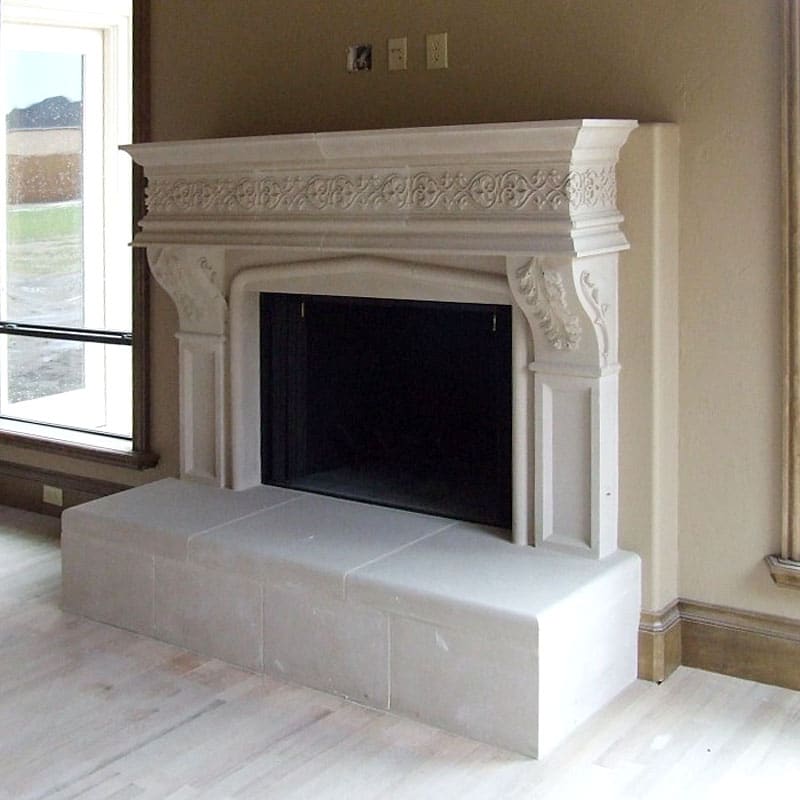
Gothic Revival cast stone fireplace mantel with intricate carved tracery, pilaster columns, and raised-panel corbeled shelf. Complex classical profiles like this are achievable through Mesa Precast's in-house mold-making process — no hand carvers required.
Modern Sculptural GFRC Fireplaces
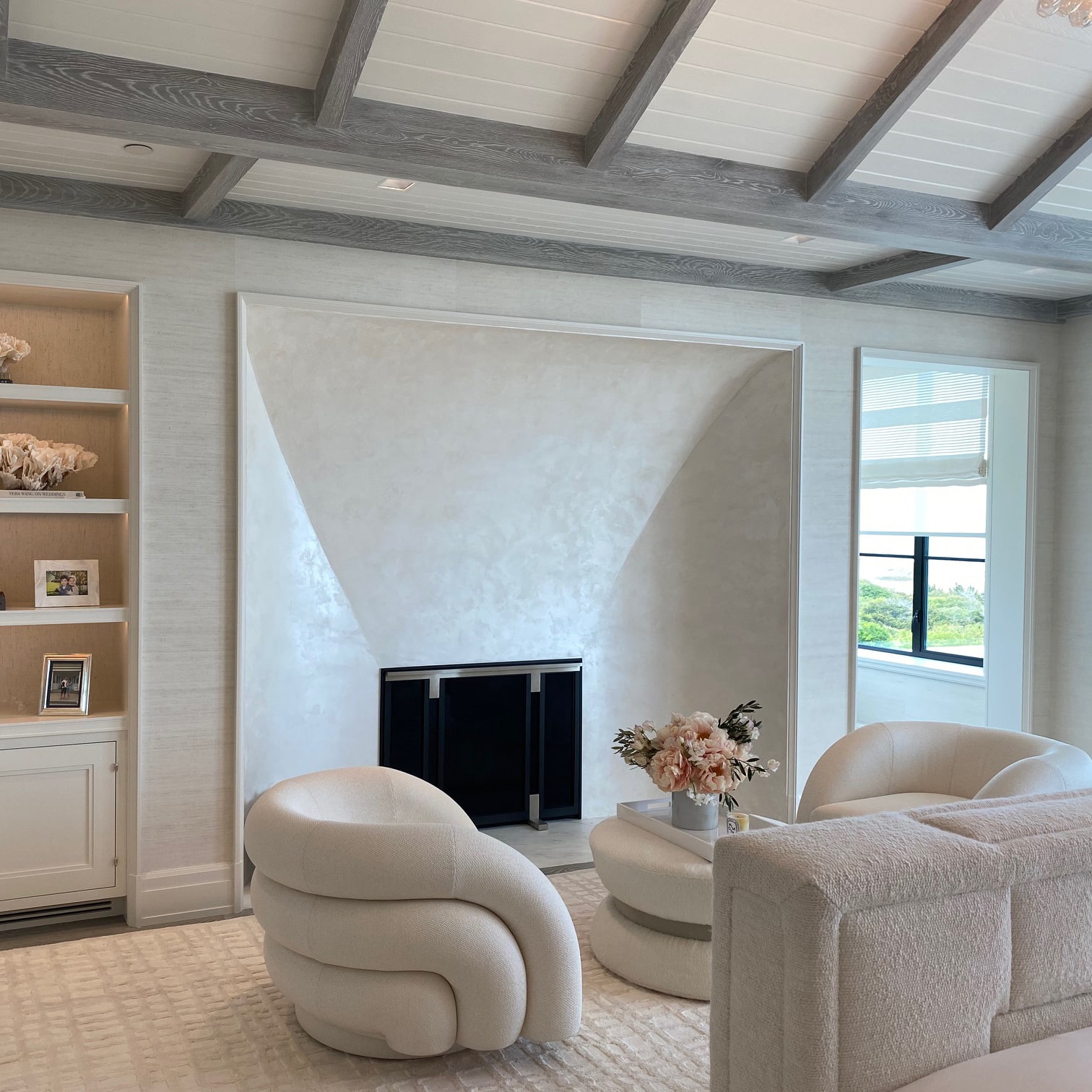
Modern GFRC fireplace feature with clean geometric form and matte concrete finish. The ultra-thin shell profile is only possible with glass fiber reinforced concrete.
Where classical design celebrates ornament and proportion, contemporary design strips everything away. Modern fireplace surrounds are architectural objects: precise, geometric, material-honest. And GFRC — Glass Fiber Reinforced Concrete — is the ideal material for realizing them.
GFRC's defining characteristic is its shell construction. Unlike solid cast stone, GFRC skins are typically 3/4” to 1-1/4” thick, reinforced with alkali-resistant glass fibers. This allows forms that would be impossible in traditional concrete: sharp-edged reveals, dramatic cantilevers, curved surfaces, and ultra-thin profiles that read as monolithic slabs.
Modern GFRC Fireplace Forms
- Linear slab surrounds — Full-height concrete slabs flanking and capping a firebox, often floor-to-ceiling in living rooms
- Floating mantel shelves — Cantilevered GFRC slabs with no visible support, 3”–4” thick
- Curved panel wraps — Concave or convex faces wrapping around a firebox, achievable in GFRC without stone-cutting
- Reveal and shadow line assemblies — Horizontal and vertical reveals at precise depths creating a modular, grid-based appearance
- Integrated hearth and surround systems — Single material expression from hearth slab through surround to ceiling or wall plane
- Outdoor fire wall panels — Large-format GFRC panels forming a backdrop behind a linear outdoor fire feature
GFRC Finishes for Modern Fireplaces
Mesa Precast offers a broad palette of GFRC finishes suited to contemporary design:
- Integral color matte — Flat, unsealed concrete appearance in custom mix colors (warm white, cool gray, charcoal, sand)
- Light sand blast — Opens aggregate for textural depth while maintaining clean geometry
- Acid wash — Reveals matrix and aggregate for a warm, variegated surface
- Smooth form finish — Glass-smooth surface for pure monolithic appearance
- Board-formed texture — Horizontal wood grain texture cast into GFRC for a reclaimed concrete aesthetic
Modern GFRC fireplace design is particularly popular in Arizona, Colorado, Utah, and New Mexico luxury homes, where the material connects to a regional design vocabulary of desert modernism: earthy tones, raw surfaces, and clean geometry in dialogue with landscape.
Indoor Fireplaces for Luxury Homes
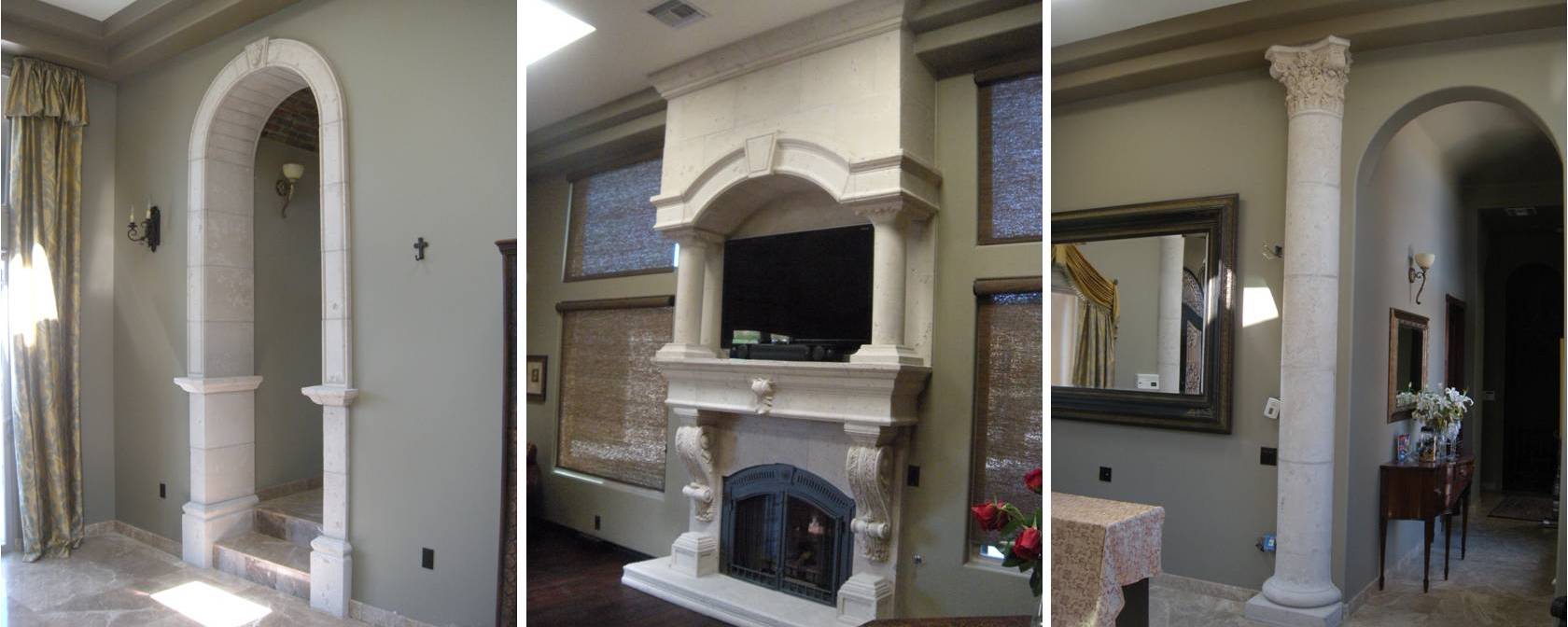
Interior cast stone fireplaces by Mesa Precast: elaborate mantels with corbels and classical profiles for formal living rooms, or clean-lined GFRC surrounds for contemporary interiors. Custom profiles at any scale.
For interior designers and architects specifying fireplaces in high-end residential projects, cast stone and GFRC offer something natural stone cannot: a single manufacturer for every room in the house. The same supplier who builds the classical surround for the formal living room builds the modern GFRC mantel for the primary suite, the cast stone fireplace in the study, and the outdoor cast stone fire feature on the covered terrace.
Consistency of material, finish, and tone across a project is far easier to achieve when sourcing from one manufacturer. Natural stone sourced from different quarries in different countries will never match — and will arrive on different schedules.
Interior Application: Room by Room
| Room | Typical Style | Best Material | Key Considerations |
|---|---|---|---|
| Formal Living Room | Classical / Transitional | Cast Stone | Full pilaster columns, overmantel, mantel shelf |
| Great Room / Open Plan | Contemporary / Transitional | GFRC or Cast Stone | Scale to room height; often floor-to-ceiling |
| Primary Suite | Modern / Minimalist | GFRC | Thin floating shelf, understated surround |
| Study / Library | Traditional / Arts & Crafts | Cast Stone | Corbeled shelf, inglenook potential |
| Wine Room / Cellar | Rustic / Gothic Revival | Cast Stone | Rough-hewn finish, thick jamb profiles |
| Media Room | Contemporary | GFRC | TV above fire — linear clean frame preferred |
Specifying tip: For luxury fireplace surrounds in Colorado, factor in altitude effects on concrete curing. Mesa Precast manufactures in controlled conditions regardless of job site elevation — field curing issues associated with site-cast concrete don't apply.
Outdoor Fireplace Surrounds: The Sun Belt Advantage
Outdoor fireplaces are one of the most requested features in luxury home design across the Sun Belt — and for good reason. In Arizona, Texas, Florida, Southern California, Georgia, Alabama, New Mexico, Utah, and Colorado, mild winters and outdoor living culture make a covered terrace or pool deck fireplace a year-round amenity, not a seasonal luxury.
Outdoor fireplace surrounds face demands that interior applications don't: UV exposure, thermal cycling, freeze-thaw stress, moisture infiltration, and insect exposure. Cast stone and GFRC perform reliably in all of these conditions. Natural limestone, by contrast, is highly porous and requires annual sealing; travertine spalls at freeze-thaw interfaces; marble discolors from acid rain and pool chemistry.
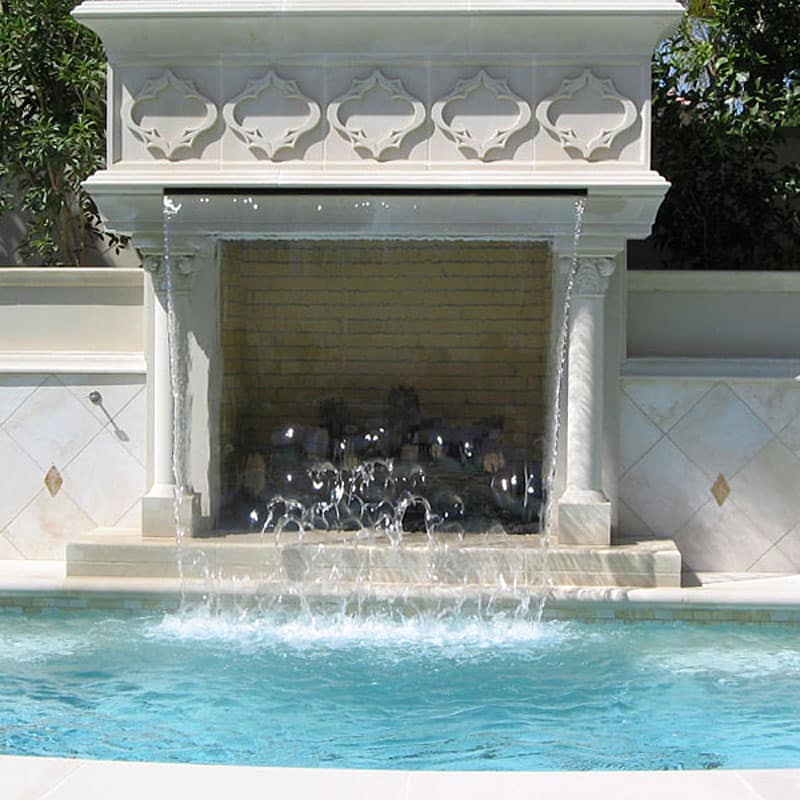
Cast stone pool fireplace surround with arabesque balustrade cornice and integrated waterfall feature cascading into the pool. Combined fire-and-water applications are a specialty of luxury outdoor living design — cast stone handles both the heat exposure and continuous moisture without degradation.
Outdoor Cast Stone Fireplace Surrounds: Arizona & New Mexico
In desert climates — Scottsdale, Sedona, Tucson, Santa Fe, Albuquerque — outdoor fireplaces serve a different function than elsewhere: evening warmth in climates where nights drop 30–40°F below afternoon highs. A cast stone fireplace surround in Arizona or a cast stone fire feature in New Mexico becomes the anchor of an outdoor living room used 9–10 months a year.
Desert design vocabulary translates beautifully into cast stone: adobe-inspired forms, thick plaster-over-block aesthetics replicated in cast stone, earth-toned finishes (ochre, terracotta, sandstone), and corbeled profile details that echo Pueblo Revival architecture. For outdoor fireplace surrounds in Arizona and New Mexico, cast stone with a rough-hewn or sand-blasted finish in warm desert tones is the specification of choice for architects working in regional modernism.
Outdoor GFRC Fireplaces: Southern California & Colorado
Outdoor cast stone fireplaces in Southern California skew contemporary — clean-lined panels, integrated seating walls, and linear fire features set into hillside terraces with ocean views. GFRC is the preferred material because of its low weight (critical on sloped sites), moisture resistance, and ability to form the large-format panels that contemporary California outdoor design demands.
In Colorado mountain resort communities — Aspen, Telluride, Steamboat, Vail — outdoor fireplaces must handle genuine freeze-thaw cycling. GFRC with alkali-resistant glass fibers and proper mix design performs reliably through mountain winters, while providing the contemporary aesthetic that resort architecture demands. A custom outdoor fireplace in Utah in Park City or St. George faces similar climatic demands with similar performance expectations.
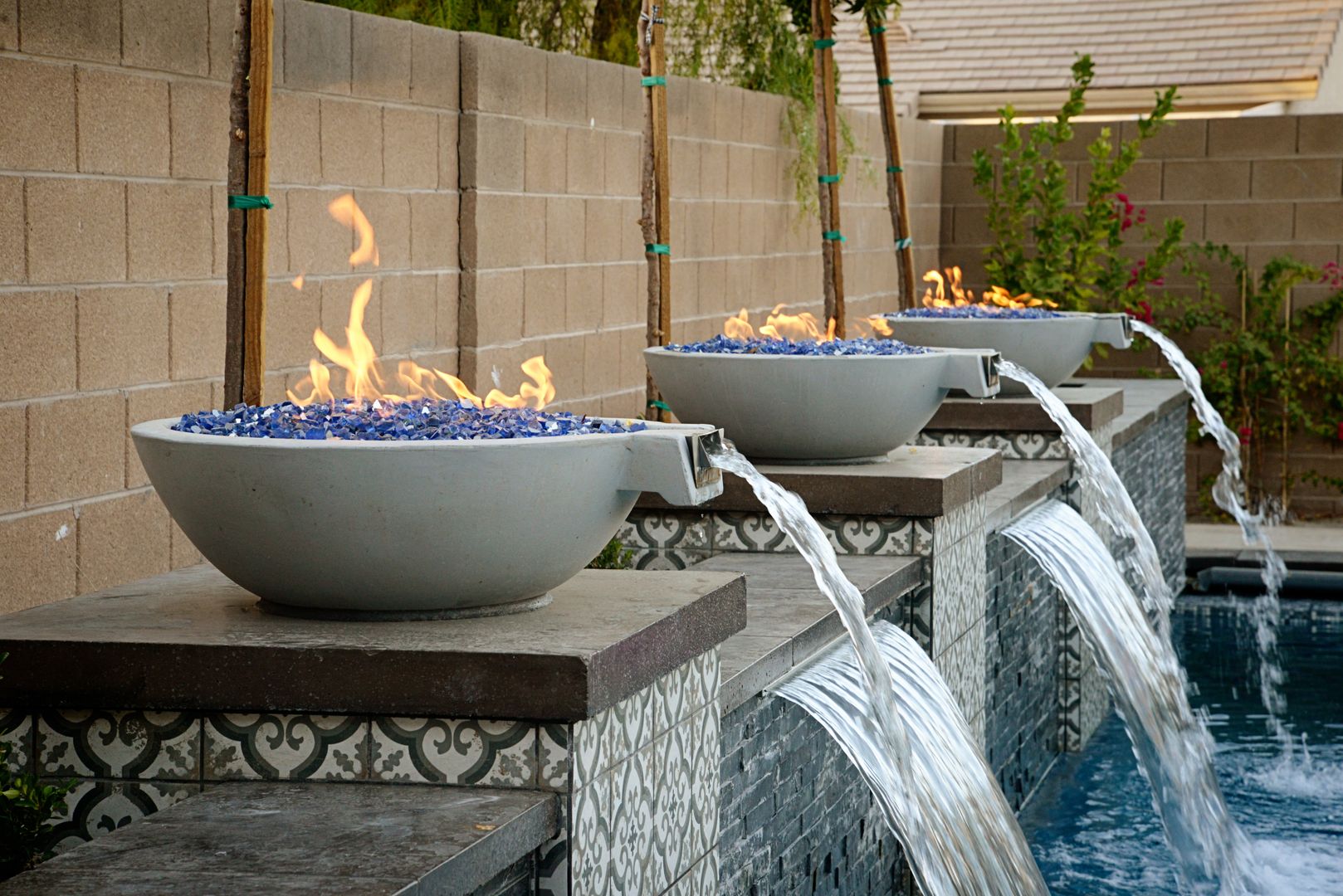
GFRC fire-and-water bowls with blue fire glass media and integrated water spillways along a pool deck edge. The thin-shell GFRC casting process allows simultaneous fire bowl and water scupper channels to be formed as a single unit — a contemporary fire feature type growing in demand across Arizona, Southern California, and Texas luxury pools.
Outdoor Fireplaces in the Gulf Coast & Southeast
Texas, Louisiana, Alabama, Georgia, and Florida represent the largest outdoor living markets in the country. In these climates, outdoor fireplaces serve as year-round social anchors for pool decks, covered porches, and outdoor kitchens.
- GFRC outdoor fireplace in Florida: High humidity, salt air exposure (coastal), and UV intensity demand a material that doesn't spall, discolor, or require annual maintenance. GFRC seals well, handles moisture, and doesn't suffer the cracking issues that natural cut stone develops in Florida's thermal cycling. Outdoor fireplace surrounds in Florida are increasingly spec'd in GFRC for this reason.
- Outdoor fireplace mantel in Georgia: Southern estate architecture frequently places large cast stone fireplaces on covered porches — wide, classical mantels that match interior detailing and extend the home's architectural language into the landscape.
- Exterior fireplace surround in Alabama: Similar estate traditions; cast stone in limestone tones with classical profiles is standard for high-end residential projects in Birmingham, Huntsville, and Mobile.
- GFRC fireplace in Texas: The Texas outdoor living market is massive. Both classical (Dallas estate homes) and contemporary (Austin modern, Houston transitional) applications are common. Mesa Precast ships directly to Texas job sites from its Arizona and Colorado manufacturing locations, with lead times competitive for the market.
- Cast stone mantel in Louisiana: Louisiana architecture — from New Orleans French Quarter to Baton Rouge estate homes — has deep classical traditions. A cast stone fireplace mantel in Louisiana often references French Colonial or Italianate detailing, with plaster finishes or a classic limestone-colored mix.
Planning an outdoor fireplace project? Use our estimator to get budgetary pricing on cast stone or GFRC fireplace surrounds, mantels, and fire feature panels.
Get an Estimate →Outdoor Fireplace Configuration Options
| Configuration | Best Application | Material Recommendation |
|---|---|---|
| Freestanding surround on masonry firebox | Covered patio, outdoor living room | Cast Stone — classical or transitional profiles |
| Linear fire feature with panel backdrop | Pool deck, outdoor kitchen, terrace | GFRC — large-format panels, clean geometry |
| Built-in fireplace with integrated seating wall | Courtyard, garden room, estate terrace | Cast Stone caps + seating wall coping |
| Double-sided indoor/outdoor fireplace | Great room to pool deck transition | GFRC (weight and moisture resistance) |
| Outdoor kitchen fireplace with hood | Full outdoor kitchen suite | Cast Stone surround + GFRC hood panels |
Regional Markets: Where Outdoor Fireplaces Are Thriving
The Sun Belt and Mountain West represent the most active markets for outdoor fireplace specifications in luxury residential construction. Here's what's driving demand in each region and what architects and designers are specifying:
Arizona
Cast stone fireplace surrounds in Arizona are in high demand across Scottsdale, Paradise Valley, Sedona, and Tucson. Desert modernism and Pueblo Revival architectural styles both translate naturally to cast stone — warm earth tones, thick profiles, and textural finishes. Outdoor fireplace surrounds in Arizona anchor outdoor living rooms used from September through May.
Southern California
In Los Angeles, Orange County, San Diego, and Santa Barbara, outdoor fireplaces are year-round features. Custom stone fireplace mantels in Southern California range from classical Spanish Colonial surrounds (Montecito, Pasadena) to ultra-modern GFRC fire walls (Venice, Malibu). Both are achievable from the same manufacturer.
Colorado & Utah
Luxury fireplace surrounds in Colorado — particularly in mountain resort communities — demand materials that perform through real freeze-thaw cycling. GFRC's glass fiber reinforcement and dense matrix hold up where natural stone and even standard precast concrete can develop problems. Custom outdoor fireplaces in Utah in Park City, St. George, and Moab follow similar patterns.
Texas
Texas outdoor living is a category unto itself. From sprawling Houston estate homes to contemporary Austin pool decks, the GFRC fireplace Texas market continues to grow. Mesa Precast manufactures both classical and contemporary profiles for the Texas market, with local delivery capability.
Florida
Coastal Florida — Miami, Palm Beach, Naples, Sarasota — demands moisture- and salt-tolerant materials. GFRC outdoor fireplaces in Florida outperform natural stone in coastal environments. Interior applications in Florida luxury homes follow both classical (Palm Beach) and contemporary (Miami) traditions.
Georgia, Alabama & Louisiana
Estate and plantation-style architecture across the Deep South places significant emphasis on classical fireplace surrounds, both interior and covered porch exterior. Outdoor fireplace mantels in Georgia, exterior fireplace surrounds in Alabama, and cast stone mantels in Louisiana are typically classical profiles in limestone tones — matching the architectural language of the home.
New Mexico
Santa Fe and Taos luxury architecture is deeply rooted in Pueblo Revival and Spanish Colonial traditions. Cast stone fire features in New Mexico often feature smooth plaster-like finishes in Adobe White or Sedona Buff, with rounded kiva-inspired forms achievable through custom GFRC molds.
Mesa Precast Custom Mold-Making: Any Design Is Possible
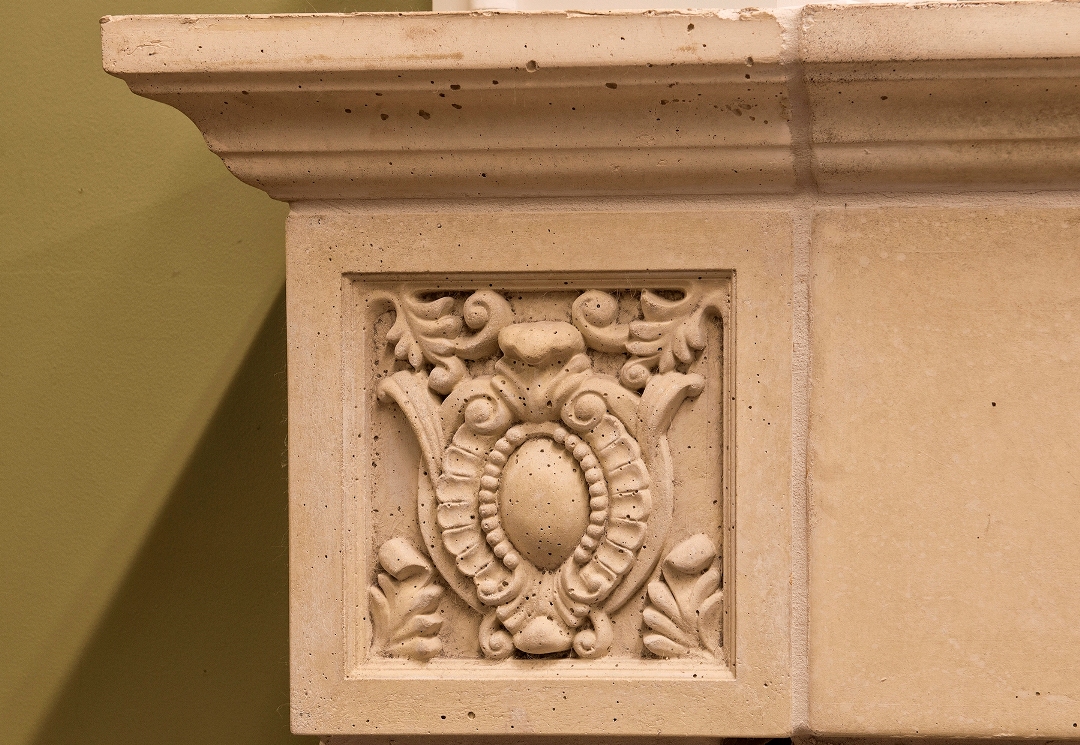
Every Mesa Precast fireplace surround starts with a custom mold. Whether you're matching an existing historical profile or designing something entirely new, the mold investment is typically $500–$2,000 and amortizes over as few as 10–15 units.
The defining capability that sets Mesa Precast apart is in-house custom mold fabrication. This means that when a designer has a specific vision — a capital profile not in the standard catalog, a curved hearth form, an overmantel panel matching an existing room's historic detailing — Mesa can build the mold and produce it.
Custom mold-making is the difference between:
- Compromising on a "close enough" standard profile from a catalog
- Getting exactly the profile the design calls for
For restoration and renovation projects — where the goal is matching existing cast stone details on a historic home or adding a fireplace surround that reads as original to a 1920s Georgian Revival — custom molds allow profile replication from field measurements or photographs. For new construction, custom molds enable original designs** that no other manufacturer offers.
Custom Mold Process
- Design input — Architect or designer provides profile drawings, CAD files, or physical templates
- Shop drawing review — Mesa Precast engineers review for castability and structural requirements
- Mold fabrication — CNC-cut foam or handcrafted wood/fiberglass mold, depending on geometry
- Sample casting — One or two sample units produced for approval
- Production run — Full quantity cast from approved mold
- QC and delivery — Units inspected, labeled, and shipped to site
For a custom stone fireplace mantel, this process takes 8–12 weeks from approved shop drawings — compared to 20–30 weeks for natural stone carving, assuming carvers are available at all.
Mold ownership: Molds built for a project are retained by Mesa Precast for future use. If you reuse a profile on a subsequent project, there's no mold fabrication cost for identical profiles — just setup and casting time. This matters for production builders and designers who use consistent profiles across multiple projects.
Cast Stone vs. Natural Stone for Fireplaces
| Factor | Cast Stone / GFRC | Natural Limestone / Marble |
|---|---|---|
| Material cost (typical mantel) | ✓ $4,500–$12,000 | $18,000–$45,000+ |
| Weight (full classical surround) | ✓ 200–450 lbs | 800–1,400 lbs |
| Lead time (custom profiles) | ✓ 8–12 weeks | 16–30+ weeks |
| Custom profile capability | ✓ In-house mold fabrication | ⚠ Hand-carving only; rare craftsmen |
| Color and finish consistency | ✓ Batch-controlled integral color | ⚠ Natural variation between pieces |
| Outdoor durability (UV, moisture) | ✓ Sealed, low absorption | ⚠ Porous; requires annual sealing |
| Freeze-thaw performance | ✓ Engineered mix design | ⚠ Variable by stone type |
| Installation complexity | ✓ Pre-formed units, mechanical fastening | Requires stone setters; heavy lift |
| Replication / matching | ✓ Exact profile replication possible | Quarry matching difficult |
| Visual authenticity at close range | ⚠ Excellent; slightly different at touch | ✓ True stone character |
The Manufacturing Process
Understanding how cast stone and GFRC are made clarifies why the material performs so well for fireplace surrounds specifically.
Cast Stone Process
Cast stone is manufactured using a dry-tamp or wet-cast method, with a cementitious mix incorporating fine aggregates, mineral pigments, and pozzolanic materials. The mix is placed into form molds under vibration, cured in controlled conditions, and demolded at 24–48 hours. The result is a dense, low-absorption unit with compressive strengths typically exceeding 6,500 psi — stronger than most natural limestone.
Surfaces are ground, sand-blasted, or left form-finished depending on specification. Color is integral — meaning the tone runs through the entire unit, so chips and wear don't expose a different-colored interior as they do with painted or coated products.
GFRC Process
GFRC is a premix or spray-up manufactured composite of Portland cement, fine aggregate, alkali-resistant glass fibers, polymer, and water. For fireplace applications, Mesa Precast typically uses a face coat (3/8” of integral-colored matrix) backed by a structural shell (3/4” to 1” glass-fiber reinforced layer). The result is a lightweight, high-strength panel suitable for large-format elements that would be prohibitively heavy in solid stone or precast.
GFRC panels for fireplace applications are reinforced with embedded channels or stud frames for mechanical attachment, allowing clean surface expressions without visible fasteners.
Get Started: Request a Fireplace Surround Quote
Whether the project is a classical ornate surround for a Georgia estate home, a contemporary GFRC fire wall for a Scottsdale modern, or an outdoor fireplace feature for a covered terrace in Houston — Mesa Precast has the mold-making capability, manufacturing experience, and regional delivery reach to execute it.
To start the process:
- Use the estimator for budgetary pricing based on project type, style, and scale
- Request a quote with your drawings or concept images for firm pricing
- Our team will review your project and respond with material recommendations, a sample timeline, and per-unit pricing within 48 hours
We manufacture and ship to Arizona, Southern California, Colorado, Utah, New Mexico, Texas, Louisiana, Alabama, Florida, and Georgia — and across the continental United States.
Ready to Design Your Fireplace Surround?
Get budgetary pricing in 48 hours. Classical ornate or modern sculptural — we build both. Any profile. Any finish. Any scale.
Use the Estimator → Request a Quote →