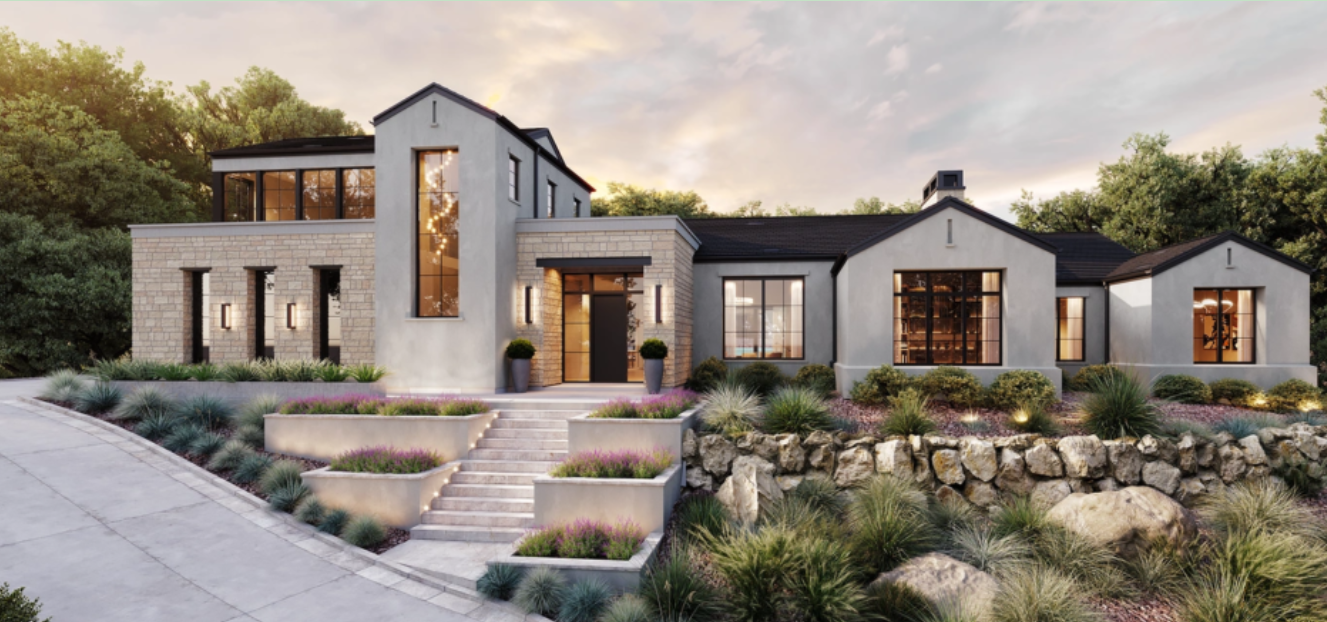
Modern luxury homes don’t look like they used to. The columns and cornices of traditional estates have given way to something different: clean horizontal planes, razor-sharp edges, and geometric precision that treats concrete not as structure but as sculpture.
In the deserts of Scottsdale and Paradise Valley, along the hills of Southern California, and across the new-build luxury markets of Austin, Dallas, and Miami, architects and designers are specifying precast concrete and GFRC for applications that would have been unthinkable a decade ago. Not columns. Not cornices. Stair treads. Bathtubs. Countertops. Wall cladding. Planters.
This is the sleek, geometric side of precast and GFRC — and it’s redefining what “luxury material” means in contemporary residential design.
Every product featured in this guide is manufactured in-house by Mesa Precast / Advanced Architectural Stone at our Arizona and Texas facilities. Custom molds, proprietary acid etch finishes, and full design-assist from concept through installation.
Acid Etch Precast Stair Treads: The Modern Floating Stair
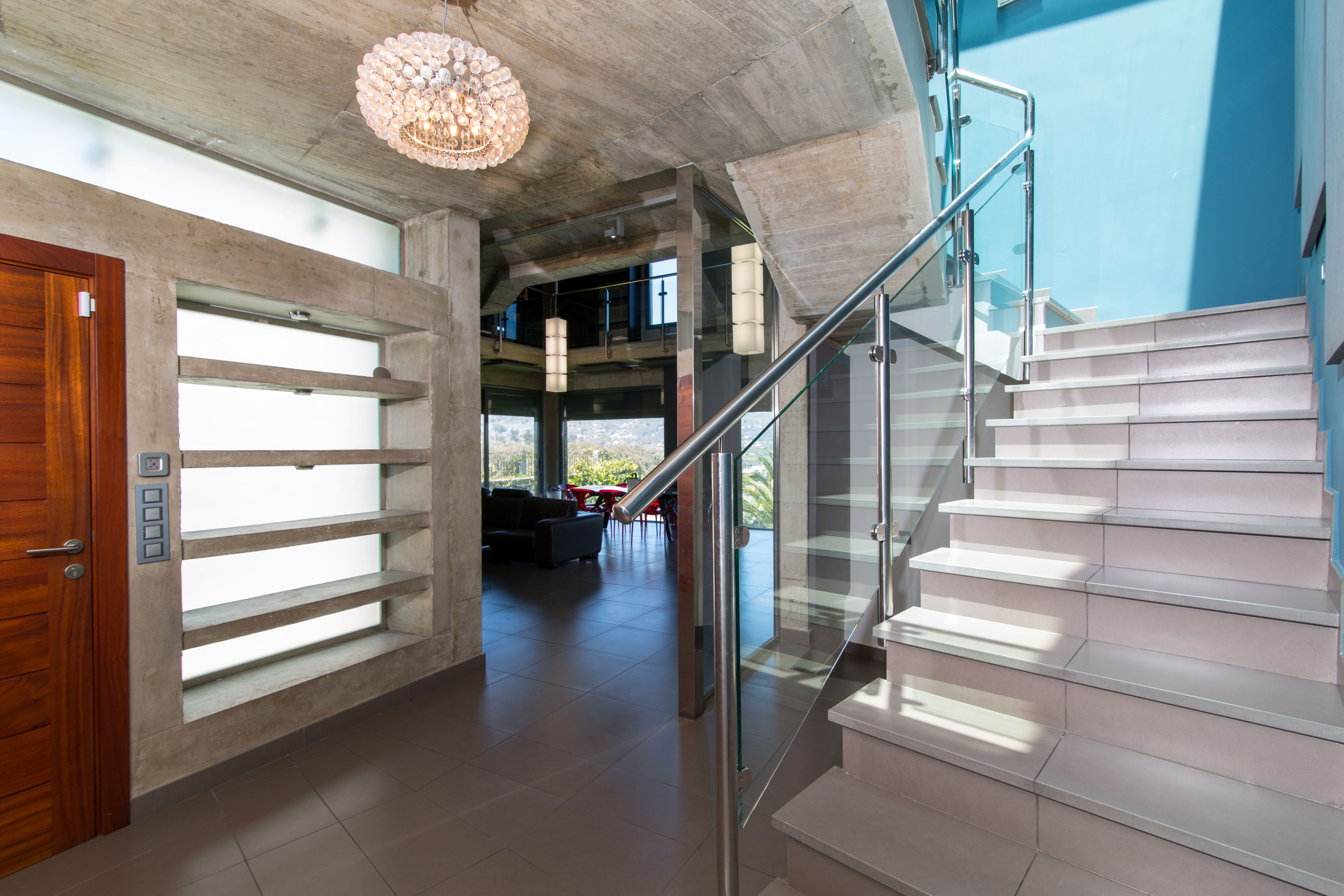
Modern concrete stair treads with precision acid etch finish — the manufacturing precision that delivers razor-sharp stair treads and custom GFRC elements for modern luxury homes. Photo: Mesa Precast.
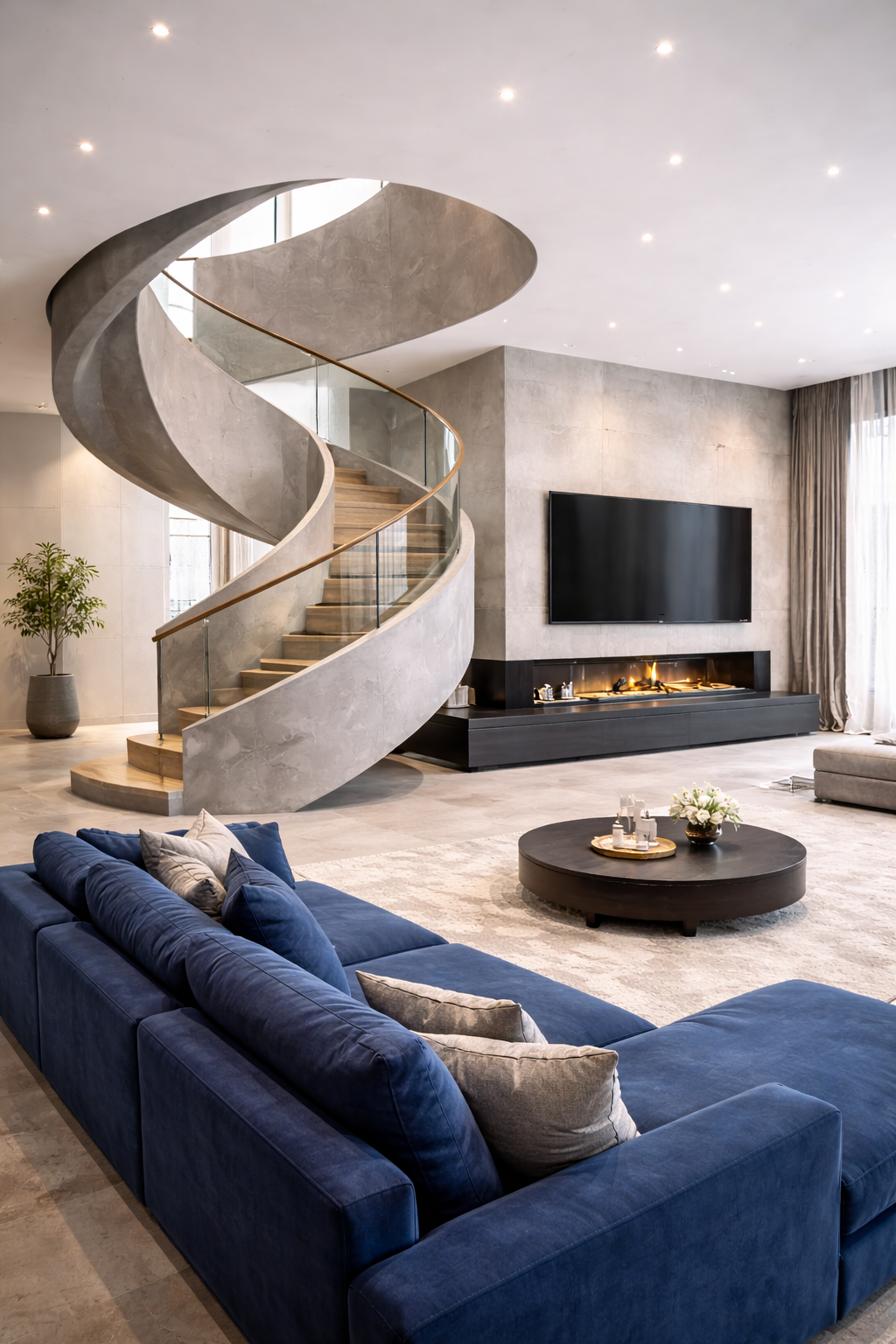
Spiral staircase with concrete treads in a modern luxury home living room — custom precast stair elements by Mesa Precast. Photo: Mesa Precast.
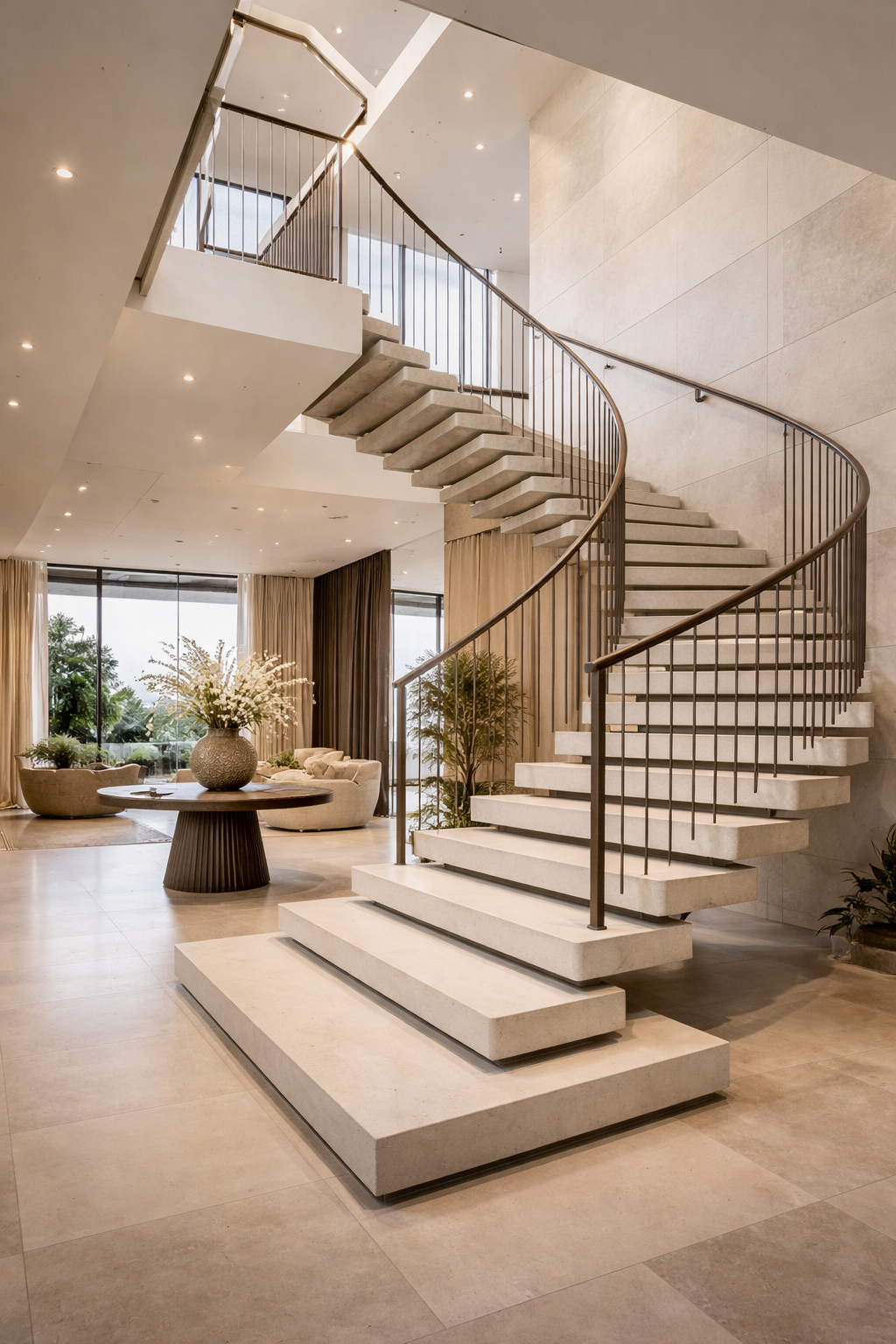
Grand curved staircase with precision concrete treads in a modern luxury home — custom precast stair elements by Mesa Precast. Photo: Mesa Precast.
The floating concrete stair has become one of the signature elements of modern luxury homes. Cantilevered from a structural wall or supported on a hidden steel stringer, acid etch precast stair treads deliver the monolithic concrete look that architects specify — without the on-site forming, curing delays, and surface inconsistencies of poured-in-place concrete.
Why Acid Etch Finish?
Acid etching removes the cement paste from the surface of cured concrete, exposing the fine aggregate beneath. The result is a matte, slightly textured surface with subtle depth and natural variation — smoother than sandblasted concrete but more tactile than polished. For stair treads, this finish provides two critical advantages:
- Slip resistance. The micro-texture created by acid etching meets ADA slip-resistance requirements while maintaining a refined visual profile. No applied coatings, no rubber inserts, no compromise.
- Visual consistency. Factory-controlled acid etch produces uniform surface quality across every tread in a flight — something that’s nearly impossible to achieve with site-poured concrete, where weather, crew variation, and curing conditions create inconsistency.
Typical Specifications
Mesa Precast manufactures precast stair treads in thicknesses from 2” to 4”, widths up to 48”, and lengths up to 12’. Custom profiles include bullnose, knife-edge, chamfered, and full-radius nosing. Every tread is cast in a precision mold and acid etched in-house, then sealed with a penetrating UV-stable sealer for exterior applications in Arizona, Texas, Southern California, Colorado, and Florida.
Acid Etch Hardscape: Patios, Walkways & Pool Decks
The same acid etch finish that makes stair treads work translates directly to outdoor hardscape. Modern luxury homes in Scottsdale, Austin, Palm Springs, and Coral Gables are replacing traditional travertine and flagstone patios with acid etch precast concrete — large-format pavers and slabs that achieve the clean, uninterrupted planes that define modern landscape design.
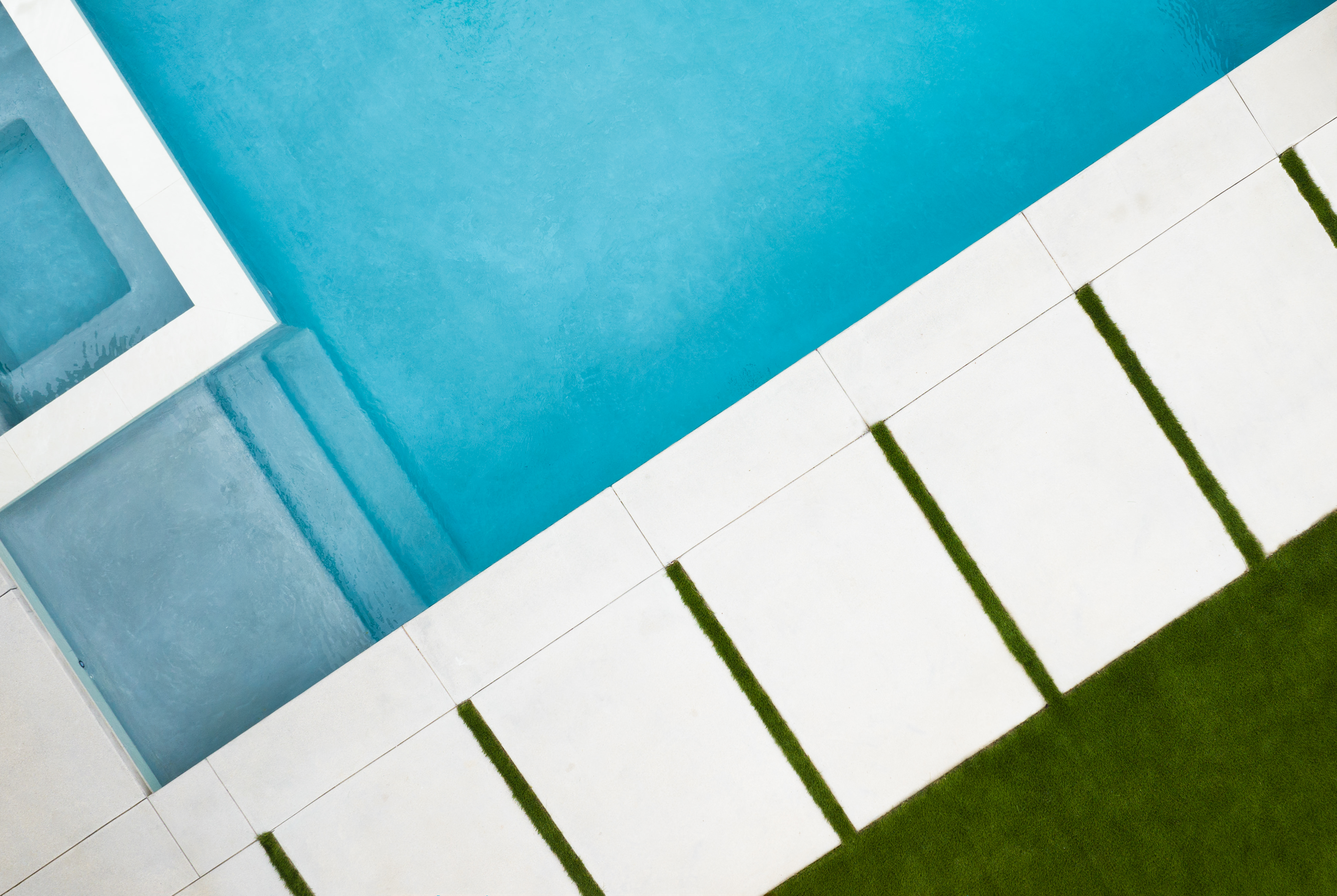
Pool coping and acid etch pavers — precision precast hardscape elements that extend the modern design language from interior to exterior. Photo: Mesa Precast.
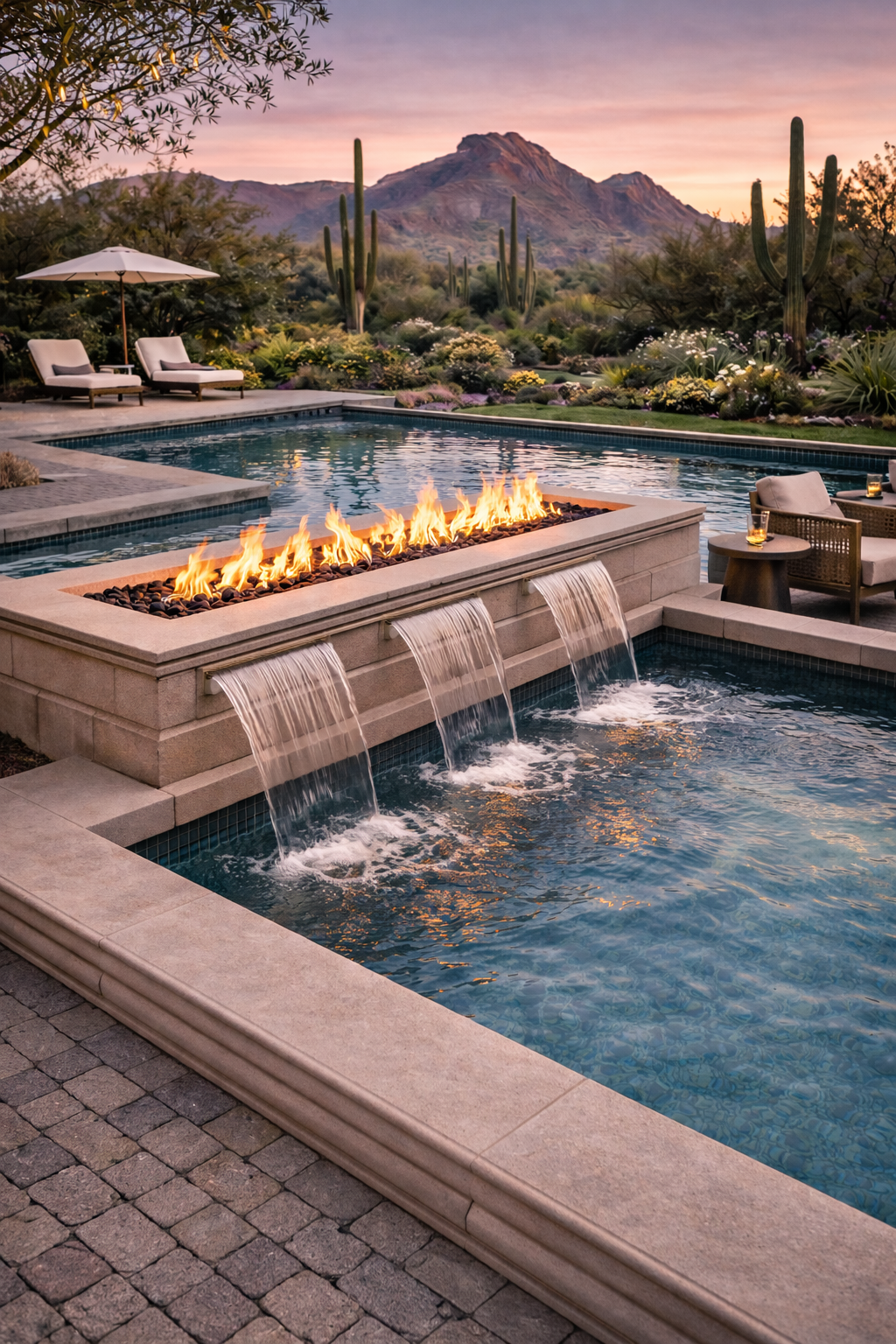
Fire and water feature in a modern luxury outdoor living space — custom GFRC and precast elements by Mesa Precast. Photo: Mesa Precast.
Applications
- Pool decks. Acid etch provides barefoot-safe texture without the rough, uneven surface of natural stone or exposed aggregate. Large-format slabs (up to 36” × 36”) minimize grout lines for the monolithic look modern pool designs demand.
- Patios and terraces. Precast pavers can be color-matched to interior concrete floors, extending the visual plane from living room to terrace — critical in the indoor-outdoor living spaces that define luxury home design in the Sun Belt.
- Walkways and motor courts. Thicker sections (3”–4”) handle vehicular loads for driveway pavers and motor court surfaces while maintaining the same refined acid etch aesthetic.
Design tip: Specify acid etch hardscape pavers in the same mix design and aggregate as your interior polished concrete floors. Mesa Precast can match the color and tone — even though the surface textures differ — creating a visual connection between indoor and outdoor living spaces.
Geometric Precast Walls: Architectural Wall Panels & Cladding
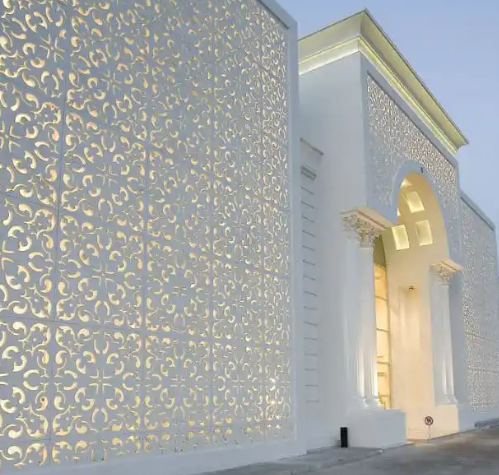
GFRC wall panels on a modern luxury home exterior — geometric precast concrete wall cladding for contemporary residential architecture. Photo: Mesa Precast.
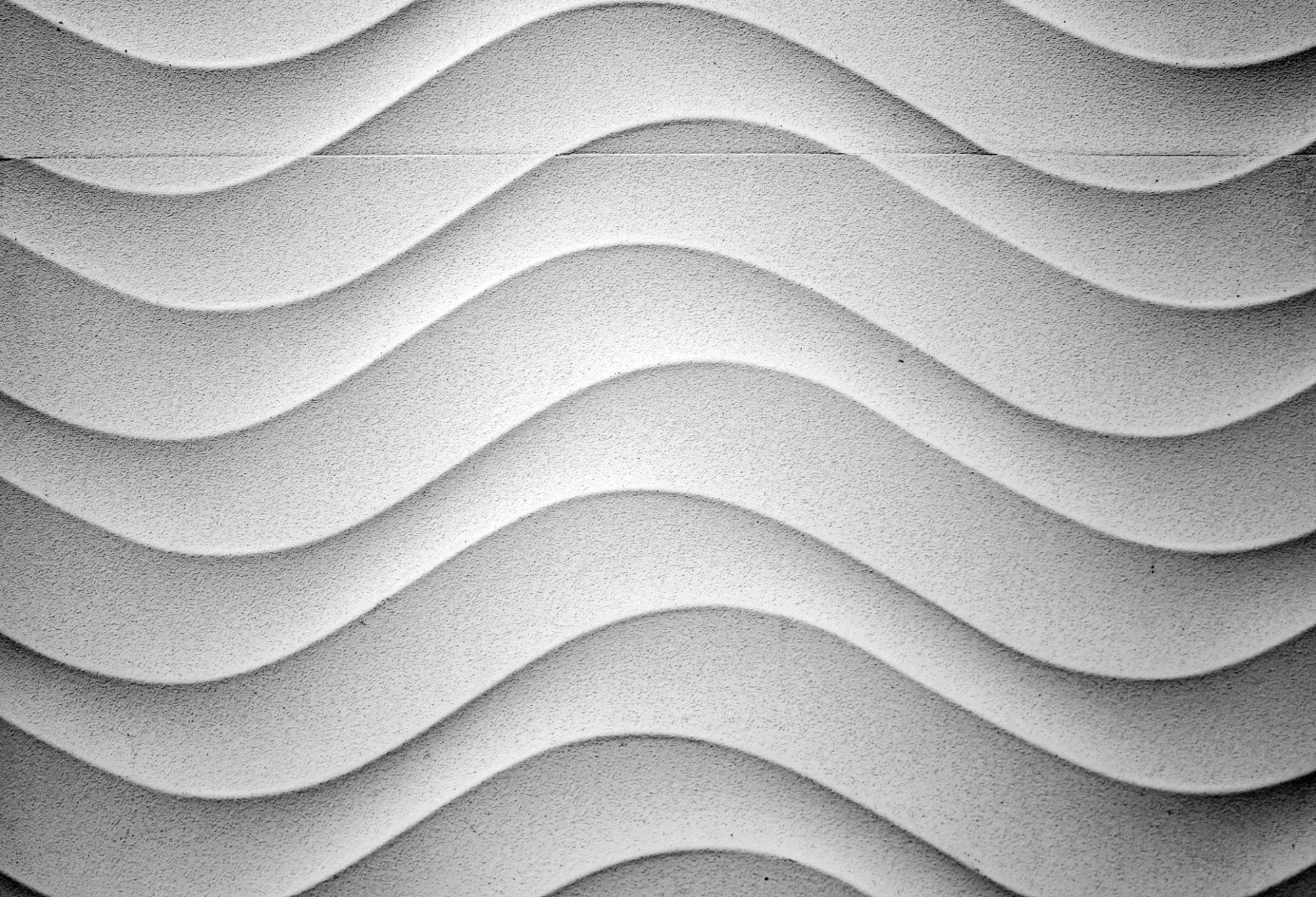
Geometric wave texture GFRC wall panel detail — precision mold-cast geometric wall panels for modern luxury residences by Mesa Precast. Photo: Mesa Precast.
Where traditional luxury homes use stone veneer for wall cladding, modern luxury homes use geometric precast wall panels — flat, angular, and precisely dimensioned. These aren’t decorative overlays. They’re architectural-grade concrete cladding that becomes the primary visual expression of the building envelope.
What “Geometric” Means in Practice
Geometric precast walls aren’t standard flat panels with a texture applied. They’re mold-cast elements with intentional three-dimensional profiles:
- Faceted panels with angled planes that catch light differently throughout the day — creating a dynamic, ever-changing facade that reads as solid mass from one angle and reveals depth from another.
- Linear ribbed panels with horizontal or vertical reveals that create shadow lines at controlled intervals — the modern equivalent of rustication without the classical vocabulary.
- Interlocking geometric modules (hexagonal, triangular, parallelogram) that tessellate across a wall surface, creating complex patterns from simple repeating units.
- Deep-relief panels with 2”–4” surface variation that turn a flat wall into an architectural feature wall, suitable for both exterior cladding and interior focal walls.
Interior and Exterior
Geometric precast walls work on both sides of the building envelope. Exterior applications use sealed, UV-stable finishes rated for the desert sun of Arizona and the salt air of Florida. Interior applications — living room feature walls, master bath accent walls, wine cellar surfaces — use the same panels in an unsealed or wax-finished state that emphasizes the raw materiality of concrete.
| Panel Type | Profile Depth | Best Application | Material |
|---|---|---|---|
| Faceted geometric | 1–3" | Exterior facade, entry walls | Precast or GFRC |
| Linear ribbed | 0.5–1.5" | Exterior cladding, privacy walls | Precast |
| Tessellating modules | 1–2" | Feature walls (interior/exterior) | GFRC |
| Deep-relief sculptural | 2–4" | Statement walls, art installations | GFRC |
Custom GFRC Planters: Architectural-Grade Landscape Elements
In modern landscape design, planters aren’t afterthoughts — they’re architecture. Custom GFRC planters serve as spatial dividers, seating edges, focal points, and design elements that integrate landscape and building into a unified composition.
GFRC is the ideal material for architectural planters because of its 75% weight reduction compared to solid precast or natural stone. A rooftop terrace planter that would require structural reinforcement in stone can sit on a standard roof deck in GFRC. A linear planter bench that would weigh 2,000 lbs in solid concrete weighs under 500 lbs in GFRC — simplifying delivery, crane requirements, and installation on luxury home sites with limited access.
Linear Trough Planters
Long, low-profile planters (up to 12’) that define outdoor rooms, edge pool decks, or line driveways. Minimal wall thickness means maximum planting volume.
Modular Cube & Cylinder Planters
Geometric repeating forms that create rhythm in modern landscape compositions. Available in custom colors to match facade panels or hardscape pavers.
Planter-Bench Combinations
Dual-function elements that combine planting with seating — the clean-line concrete bench with integrated greenery that defines modern outdoor living spaces.
Sculptural Statement Planters
One-of-a-kind forms for entry courts, motor courts, and focal landscape positions. Custom molds allow any geometry the designer envisions.
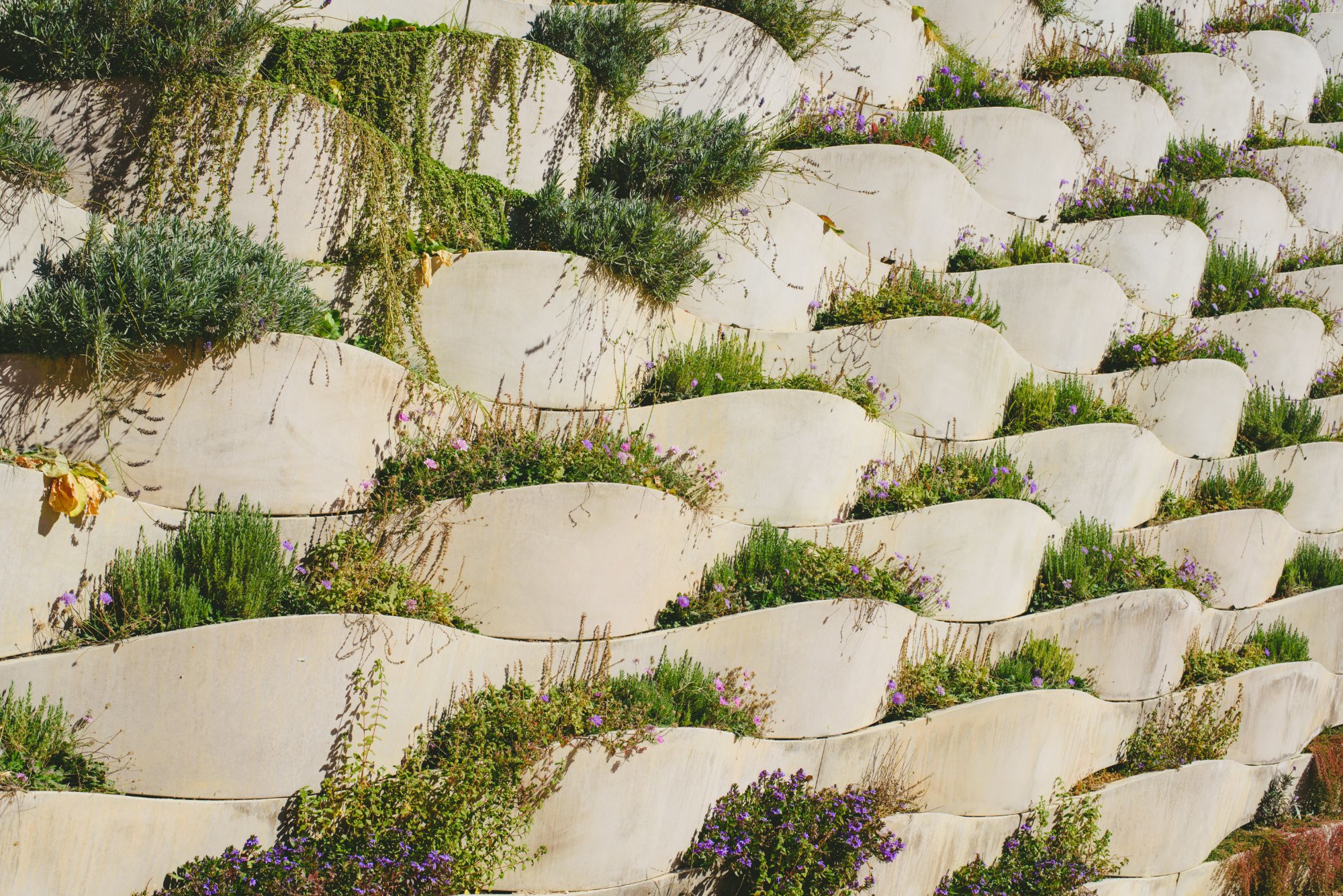
Vertical garden planter wall in a modern luxury home courtyard — custom architectural GFRC planters by Mesa Precast for modern luxury landscapes. Photo: Mesa Precast.
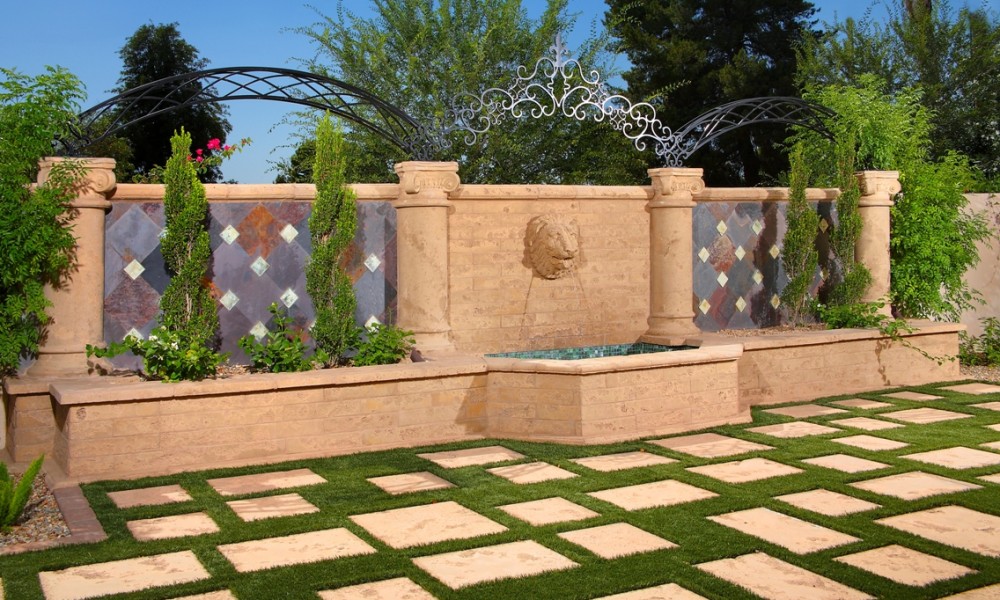
Lion head fountain detail with precast concrete pavers — custom GFRC and precast landscape elements for luxury outdoor living by Mesa Precast. Photo: Mesa Precast.
GFRC Freestanding Bathtubs: The Luxury Bathroom Centerpiece
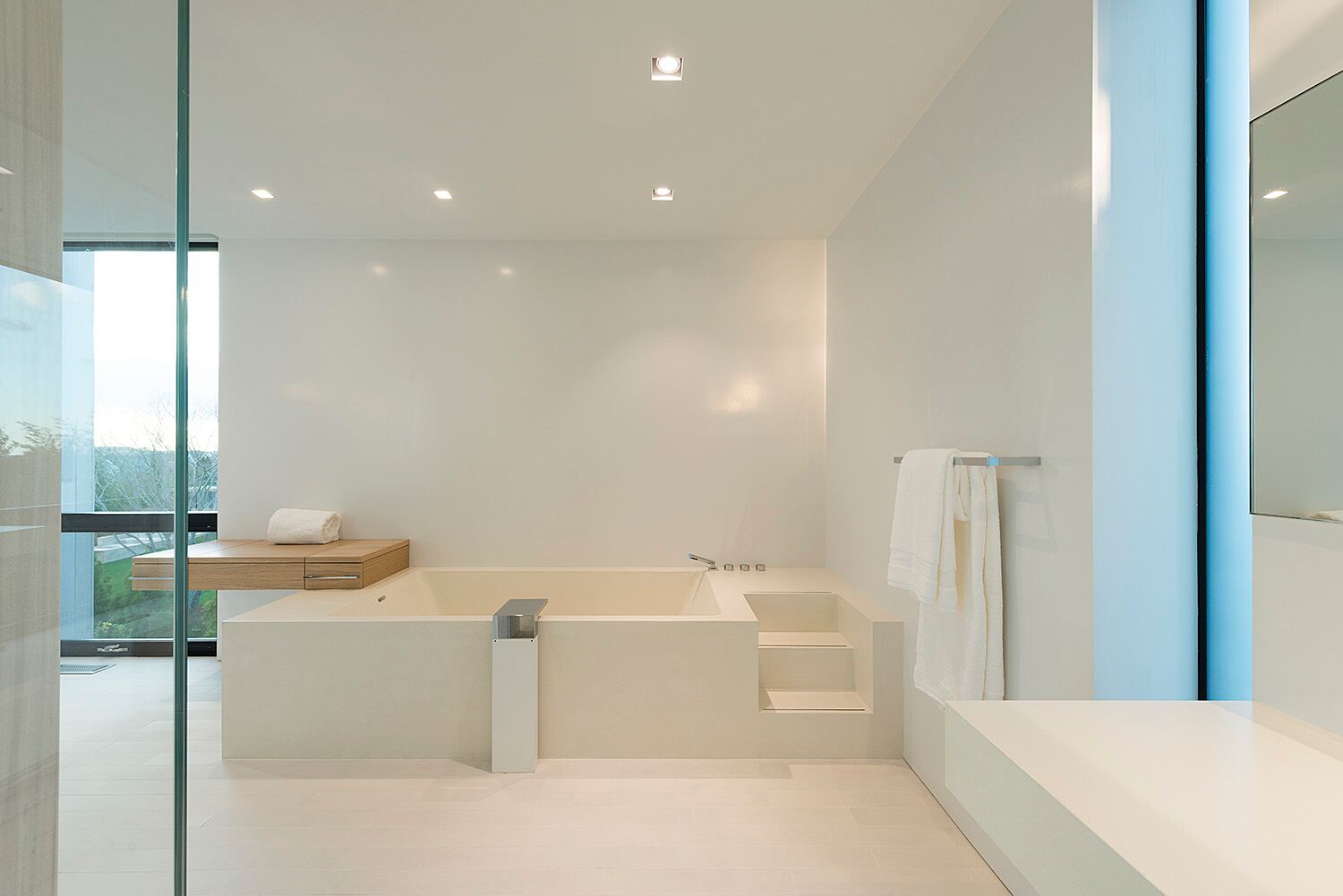
Freestanding GFRC bathtub in a modern luxury master bathroom — custom GFRC bathtubs by Mesa Precast for modern luxury residential design. Photo: Mesa Precast.
A freestanding GFRC bathtub is the kind of element that defines a room. Not a fixture — a piece of architecture. These are monolithic concrete forms, cast in custom molds, that bring the raw materiality of concrete into the most intimate space in the house.
Why GFRC Instead of Solid Concrete?
A solid concrete bathtub would weigh 800–1,200 lbs. That’s a structural engineering problem before it’s a design problem. A GFRC tub achieves the same visual mass at 200–350 lbs — within the load capacity of standard residential floor framing. No structural upgrades. No crane access to the master bathroom.
Design Options
- Oval freestanding. The classic soaking tub form, executed in GFRC with wall thicknesses as thin as 1”. Exterior surface can be acid etch, smooth trowel, or textured to match other concrete elements in the home.
- Angular/geometric. Sharp-edged rectangular or trapezoidal tub forms that align with the rectilinear geometry of modern bathroom design. Impossible to achieve in ceramic or acrylic at this scale and visual weight.
- Integrated surround. Tub and surround cast as a single GFRC element — eliminating joints, grout lines, and the visual fragmentation that undermines the monolithic look modern designers specify.
Practical note: GFRC bathtubs are sealed with a food-grade, water-resistant penetrating sealer that protects the concrete from soap, oils, and mineral deposits while maintaining the natural concrete appearance. Re-seal every 2–3 years for lasting performance.
GFRC Countertops: Kitchen & Vanity Surfaces
GFRC countertops are where concrete stops being a building material and starts being a design statement. Thinner, lighter, and more precisely castable than traditional concrete countertops, GFRC enables forms and spans that solid concrete cannot achieve without cracking, deflecting, or requiring structural reinforcement beneath.
The Advantage Over Poured-In-Place Concrete Countertops
Traditional concrete countertops are poured on-site or cast in a local shop. The results vary — color inconsistency, shrinkage cracks, and surface defects are common complaints. GFRC countertops are factory-manufactured under controlled conditions: consistent color, no shrinkage cracking (the glass fiber matrix controls it), and surface quality that rivals engineered stone.
| Property | GFRC Countertop | Poured Concrete | Engineered Stone |
|---|---|---|---|
| Thickness | 3/4–1.5" | 1.5–2" | 3/4–1.25" |
| Weight per SF | 8–12 lbs | 18–25 lbs | 10–14 lbs |
| Max unsupported span | Up to 8' | 3–4' | 4–6' |
| Custom shapes | Any — mold-cast | Limited by forms | CNC-cut from slab |
| Integral color | Yes — consistent | Variable | Factory-set |
| Shrinkage cracking | Controlled by fiber | Common | None |
Kitchen Applications
GFRC kitchen countertops can span an entire island without a seam — up to 8’ in a single section with integrated waterfall edges. The material accepts integral drain boards, embedded trivets, and custom edge profiles that are cast into the mold rather than routed after fabrication. Color options range from warm cream and sand tones to charcoal and near-black, with acid etch or smooth trowel finishes.
Bathroom Vanity Surfaces
For luxury bathrooms, GFRC vanity tops can integrate the sink basin into the countertop as a single seamless element — no undermount seams, no vessel bowl joints. The basin form is part of the mold. The result is a monolithic concrete vanity that reads as sculpture, consistent with the modern aesthetic driving luxury residential design in Arizona, Southern California, Colorado, and Texas.
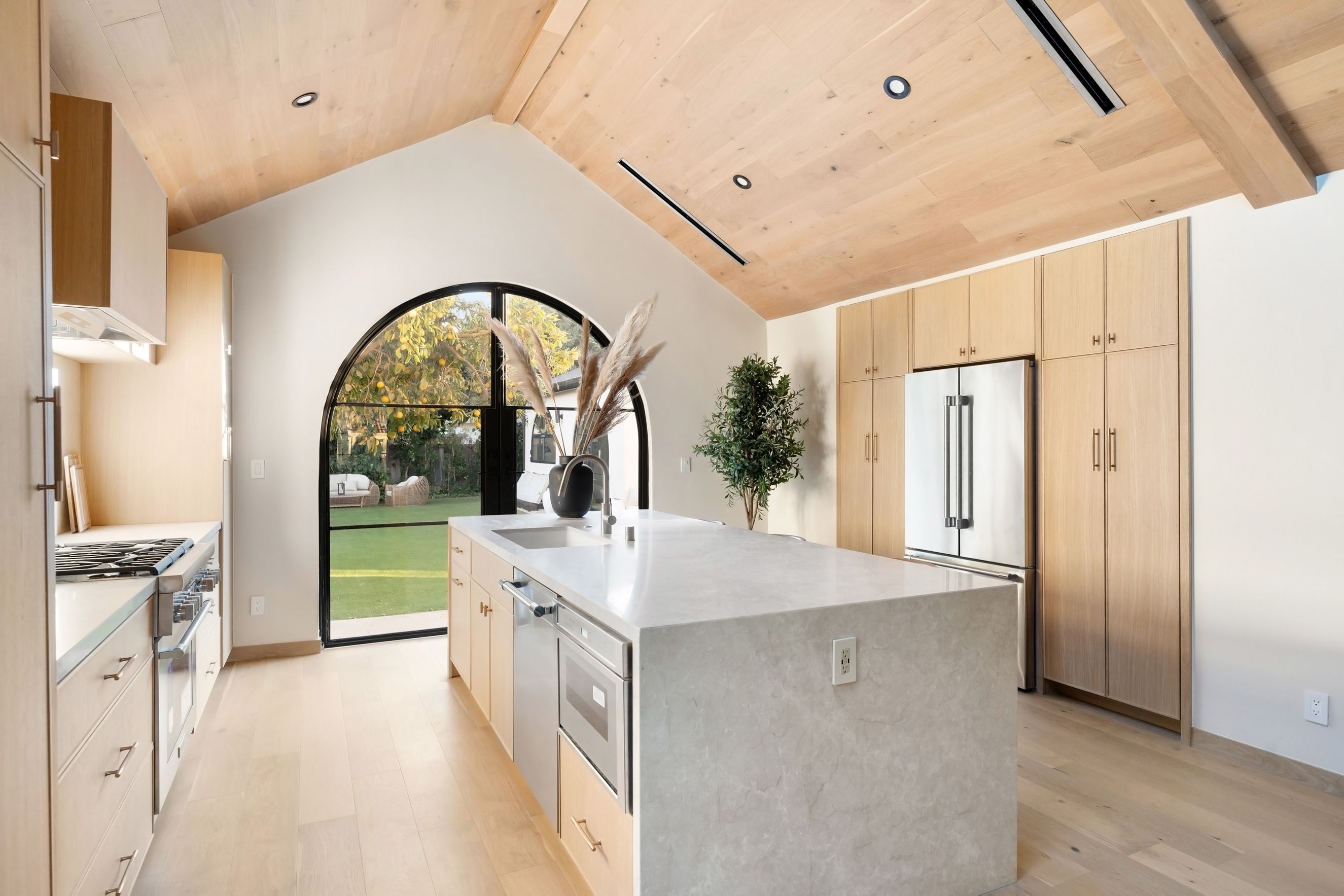
Modern luxury indoor kitchen with concrete countertops and arch window detail — custom GFRC countertops by Mesa Precast for modern luxury kitchens. Photo: Mesa Precast.
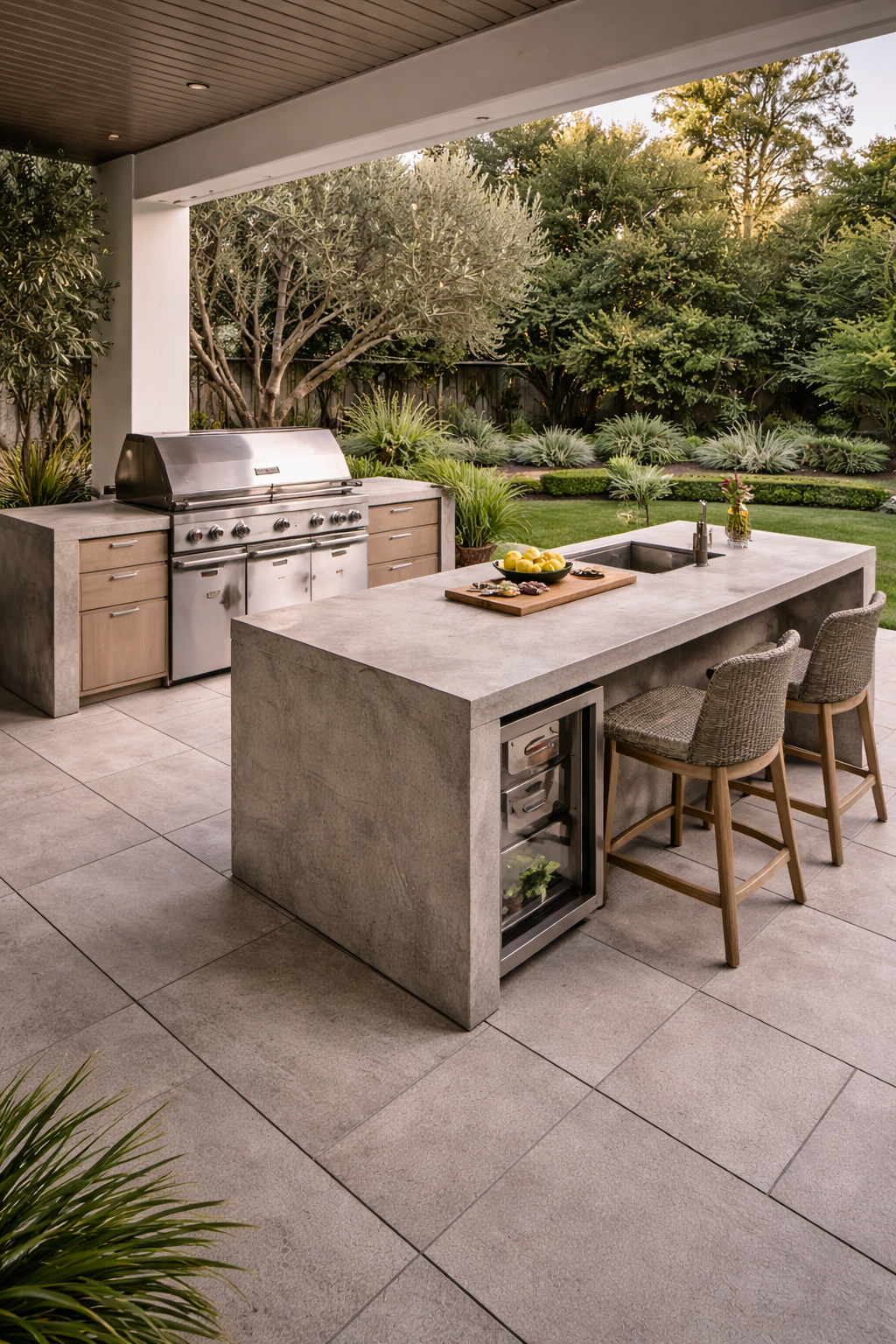
Modern outdoor kitchen island with concrete countertop — custom GFRC countertops by Mesa Precast for outdoor kitchens and luxury outdoor living spaces. Photo: Mesa Precast.
Why Precast & GFRC Over Natural Stone for Modern Luxury Homes
The modern luxury home client doesn’t want marble. They want concrete. But they want concrete that performs, that’s consistent, and that can be specified with the same precision as any other high-end finish material. That’s the case for precast and GFRC.
The Core Advantages
- Design flexibility. Custom molds mean any geometry. Organic curves, sharp angles, integrated features, compound surfaces — all achievable in GFRC without the hand-carving cost of natural stone.
- Color consistency. Integral pigmentation means every element in the home — stair treads, countertops, planters, wall panels — matches. No quarry variation, no lot-to-lot color shifts.
- Weight reduction. GFRC’s 75% weight reduction over solid concrete and natural stone simplifies structural requirements across the board. Lighter floor loads, simpler foundations, easier installation.
- Acid etch versatility. A single acid etch process produces slip-resistant stair treads, barefoot-safe pool decks, and refined interior surfaces — all from the same base material and finish technique.
- In-house manufacturing. Mesa Precast / Advanced Architectural Stone manufactures all elements in-house at Arizona and Texas facilities. No imported stone with unpredictable lead times. No third-party fabricators introducing quality variation.
All Made In-House: Mesa Precast’s Manufacturing Process
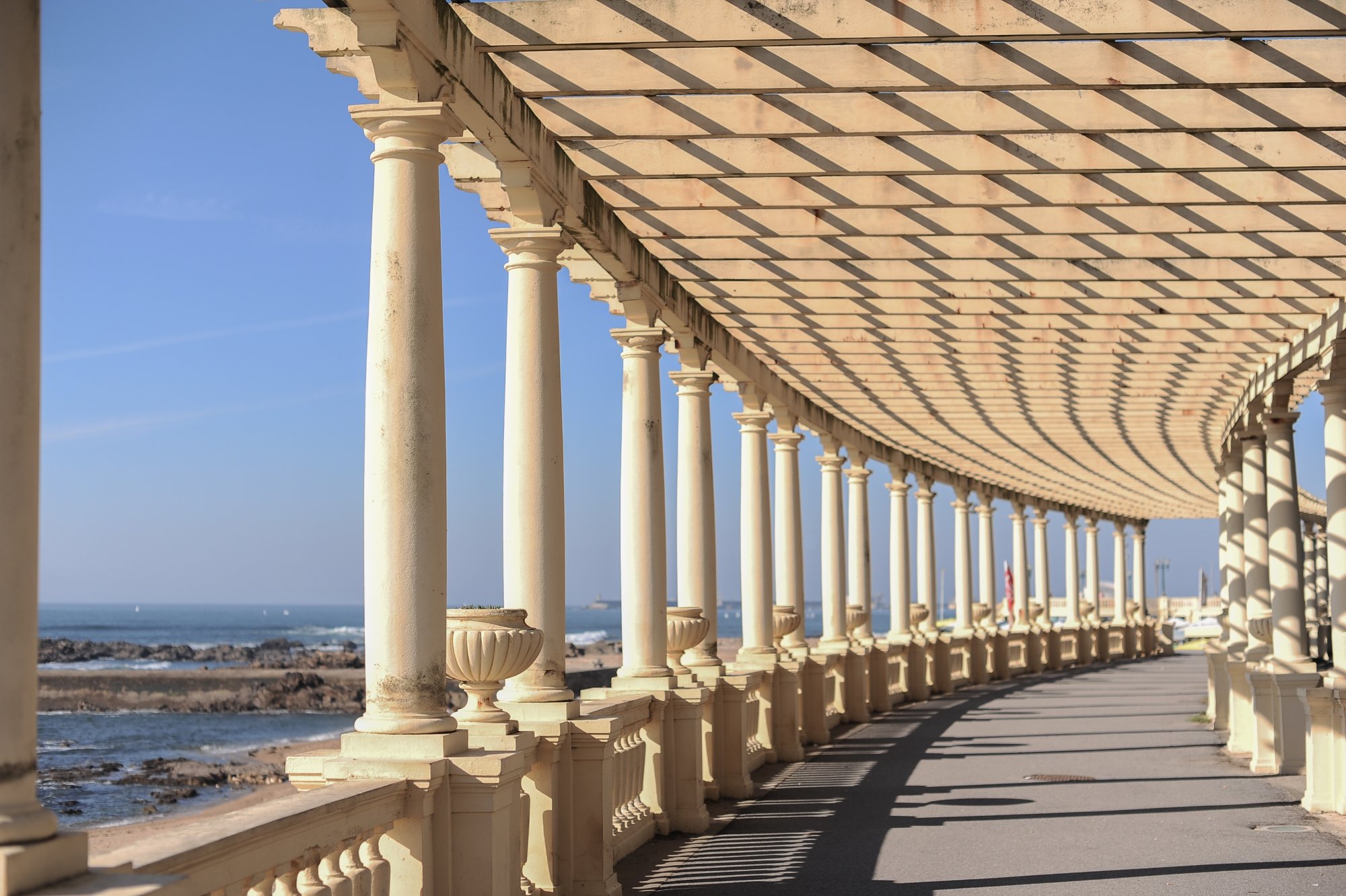
GFRC columns and pergola structure at Mesa Precast Arizona manufacturing facility — precision manufacturing at every scale from columns to custom bathtubs. The same engineering precision and quality control for luxury residential and commercial projects. Photo: Mesa Precast.
Every product featured in this guide — stair treads, hardscape pavers, geometric wall panels, planters, bathtubs, countertops — is manufactured by Mesa Precast / Advanced Architectural Stone at our own facilities. This isn’t a showroom that sources from third parties. It’s a manufacturing operation with full design-assist capability.
How It Works
- Design consultation. Your architect or designer works with our engineering team to define geometry, finish, color, and structural requirements. We review drawings (or napkin sketches) and advise on what’s achievable.
- Custom mold fabrication. Every unique profile gets a dedicated mold — CNC-machined for precision. Mold investment is a one-time cost amortized across the production run.
- Casting and finishing. Elements are cast in-house using spray-up or premix GFRC methods (or conventional precast for thicker sections). Acid etch, smooth trowel, sandblast, or bush-hammer finishes are applied in our finishing bay.
- Quality inspection. Every piece is dimensionally checked against shop drawings. Color samples are matched against approved mock-ups. Nothing ships without passing QC.
- Delivery and installation support. We ship nationwide from Arizona and Texas, with installation guidance and field support for complex elements.
Lead times: Standard residential elements (stair treads, countertops, planters) typically ship 8–12 weeks from shop drawing approval. Complex custom elements (geometric wall systems, integrated tub-surround units) run 12–16 weeks. Rush production is available for select projects.
Getting Started: From Concept to Installation
Whether you’re an architect specifying precast stair treads for a new-build modern home, a designer sourcing a GFRC bathtub for a luxury bathroom renovation, or a builder pricing geometric wall panels for a spec home in Scottsdale, Austin, or Palm Beach — the process starts the same way.
For Architects & Designers
- Send your drawings (any format: Revit, AutoCAD, Rhino, PDF, even hand sketches) and we’ll develop shop drawings and provide a production estimate.
- We offer full design-assist: if you know you want GFRC countertops but haven’t detailed the edge profile, we’ll propose options based on your project’s aesthetic.
- Mock-up samples are available for color, finish, and profile approval before production commences.
For Homeowners & Builders
- Start with our online estimator to get a ballpark budget for your project. No drawings needed at this stage.
- Have photos or inspiration images? Send them through our quote request form and our team will respond with feasibility and preliminary pricing.
- We work directly with homeowners and general contractors — you don’t need an architect as an intermediary.
Ready to Bring Modern Concrete Into Your Next Home?
Stair treads, countertops, tubs, wall panels, hardscape, planters — tell us what you’re designing and we’ll tell you what’s possible. No drawings required to start.